Pages

Wednesday, July 27, 2011

Perodua once again No. 1 on new Myvi demand 2011


KUALA LUMPUR: Strong demand for the new Myvi which hit showrooms last month may propel Perusahaan Otomobil Kedua Sdn Bhd (Perodua)back to the top of the vehicle sales chart in Malaysia.
Industry analysts opined that demand for the new Perodua might see the car company regain billing as the top car seller in the country by August or September this year.
“It's expected that they will come back (to top spot) over the next three months,” said Affin Securities Sdn Bhd analyst Chong Lee Len.
Sales of Perodua have been affected by supply disruption caused by the earthquake in Japan and also the phasing out of the old Myvi, a lull which allowed Proton Holdings Bhd to recapture the leadership in auto sales in the first half of the year.
However, more recently, indications that Perodua could be on its way up again was based on the encouraging response it has received since the launch of the new Myvi last month.
Perodua managing director Datuk Aminar Rashid Salleh said the new Myvi has now received 22,000 bookings and that the company was targeting to sell between 8,000 and 8,500 units of the new car a month.
One pleasant surprise was that the bookings for automatic version has been more than planned; currently 90% of the bookings of the Myvi were for the auto version whereas Perodua had planned 70% of production for the auto version and 30% for the manual.
“We need two to three months to adjust production to match demand for the auto from the manual version,” he said.
One benefit from that higher demand for the auto variant is that margins are typically better.
Perodua is also looking to beef up margins with the top-of-the line version of the Myvi drawing the highest demand.
Aminar said the Myvi's Elegance version, which has the highest specifications, was witnessing stronger than expected demand with orders for 4,000 to 4,500 units.
As a result, the waiting list for that variant is between 4 and 5 months while for the others, the waiting list is about two to three months.
Aminar said the company was focussed on selling as many cars as possible.
“We just want to make a value-for-money car for the public,” he said.
The new Myvi has not affected demand for the other makes of Perodua - the Alza and the Viva - but Aminar said amendments to the Hire Purchase Act has led to a 20% to 25% drop in the orders for the Viva.
Bookings for the Viva prior to the Hire Purchase Act stood at 6,000-6,5000 units a month and demand for the Alza is maintained at 2,800-3,000 units a month.
The problem, he said, stemmed from the difficulty of customers to pay the 10% booking fee for the Viva.
In the past, financing packages were structured to ease the burden of people wanting to buy Perodua's entry-level car but changes to the Hire Purchase Act has plugged such practices.
Aminar said talks were underway with banks to find a financial package solution for such buyers.
“We are trying to make the car affordable to the masses and have to come out with a more innovative package,” he said.

2011 New Proton Saga FLX 1.3L Reviewed – CVT, ABS and EBD on


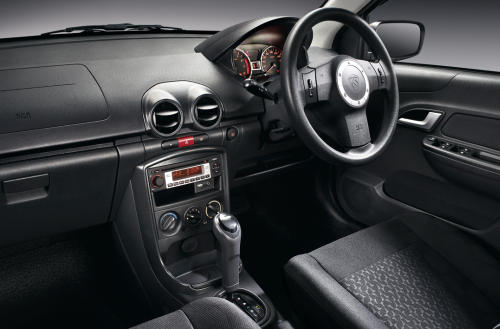
Proton has officially launched the Saga FLX 1.3L, which we managed to check out in the showroom over the weekend. The car’s entry into the market was announced today, in both manual and six-speed CVT drivetrain options and two variant forms – Standard and Executive.
Going with the FLX 1.3L Executive variant bags a list of added features, notably driver and passenger air-bags along with ABS and Electronic Brake-force Distribution (EBD). There’s no mention about any change to the engine’s output, so the assumption is that one continues on as is.
The introduction of the car follows on the company’s earlier announcement in June declaring the successful development and integration of CVT technology with its CamPro engine.
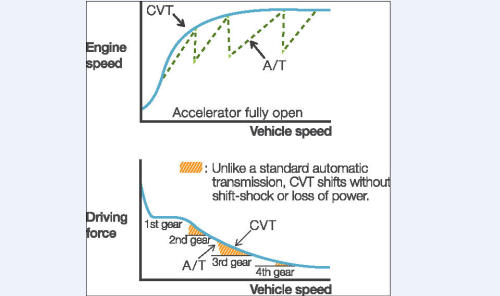
The transmission change improves the drivability and responsiveness of the car without compromising its power, said Proton’s MD Datuk Seri Syed Zainal Abidin. “Because of the lighter build of the engine, along with the ‘stepless’ gear transition that the CVT provides, the Saga FLX delivers a fuel consumption drop of 4% in an urban driving environment, with consumption dropping up to 10% when driven on highways,” he said.
“The utilisation of CVT technology has a far reaching impact to the consumer. Other than the fuel saving, the smoothness and reliability that CVT provides allows the engine to run at an optimum level, thus resulting in less engine fatigue and improving its long term durability,” he added.
Along with the new drivetrain and ABS/EBD comes a new colour as well – Elegant Brown joins the existing options of Tranquility Black, Genetic Silver, Solid White and Blue Rock in the shade lineup.
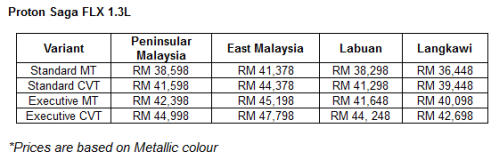
Pricing-wise, the FLX 1.3L starts from RM38,598 for the Standard manual version right up to RM44,998 for the Executive CVT variant. The Saga FLX 1.3L is now available for bookings and can be viewed at all Proton showrooms nationwide.

Source: Paultan.org

2011 New Proton Saga FLX 1.3L Reviewed – CVT, ABS and EBD on


Proton has officially launched the Saga FLX 1.3L, which we managed to check out in the showroom over the weekend. The car’s entry into the market was announced today, in both manual and six-speed CVT drivetrain options and two variant forms – Standard and Executive.
Going with the FLX 1.3L Executive variant bags a list of added features, notably driver and passenger air-bags along with ABS and Electronic Brake-force Distribution (EBD). There’s no mention about any change to the engine’s output, so the assumption is that one continues on as is.
The introduction of the car follows on the company’s earlier announcement in June declaring the successful development and integration of CVT technology with its CamPro engine.
The transmission change improves the drivability and responsiveness of the car without compromising its power, said Proton’s MD Datuk Seri Syed Zainal Abidin. “Because of the lighter build of the engine, along with the ‘stepless’ gear transition that the CVT provides, the Saga FLX delivers a fuel consumption drop of 4% in an urban driving environment, with consumption dropping up to 10% when driven on highways,” he said.
“The utilisation of CVT technology has a far reaching impact to the consumer. Other than the fuel saving, the smoothness and reliability that CVT provides allows the engine to run at an optimum level, thus resulting in less engine fatigue and improving its long term durability,” he added.
Along with the new drivetrain and ABS/EBD comes a new colour as well – Elegant Brown joins the existing options of Tranquility Black, Genetic Silver, Solid White and Blue Rock in the shade lineup.
Pricing-wise, the FLX 1.3L starts from RM38,598 for the Standard manual version right up to RM44,998 for the Executive CVT variant. The Saga FLX 1.3L is now available for bookings and can be viewed at all Proton showrooms nationwide.

Source: Paultan.org

Thursday, July 21, 2011

Malaysia: Wider urban-rural income gap


KUALA LUMPUR: The income gap between urban and rural Malaysians is bigger today than before the country gained independence, a trend that could lead to social instability.

Dr Muhammed Abdul Khalid, a Fellow with the Institute of International and Strategic Studies (ISIS), warned that high inequality trends could also affect economic growth.

"Will economic benefits trickle down to all? The income gap has widened further between the top 20 per cent and bottom 40 per cent, jumping from RM659 (1970) to RM8,547 (2009)," he said at a breakfast forum organised by the Malaysian Rating Corp Bhd (MARC) yesterday.

He compared the income trends between 2000 and 2009 which showed that while Malaysia's economy grew at an average 5.3 per cent a year, wages rose 2.6 per cent and inflation averaged 3.2 per cent.

In the workforce, 34 per cent are earning less than RM700 a month, which is a tad below the RM720 poverty line.

Separately, Malaysia Investment Development Authority (Mida) chairman Tan Sri Sulaiman Mahbob said Malaysian companies should invest more in research and development (R&D) to help boost the country's economic growth.

R&D investments could raise the number of Intellectual Property (IP), lending a higher value to gross domestic product.

Domestic investments make up 40.1 per cent of total investments in the manufacturing sector, totalling RM267.2 billion over the past five years.

"In the first five months of 2011, we are already seeing a pick up in domestic direct investments."

Earlier, MARC also launched "Musings of a Financial Economist", a collection of thought-provoking essays on key economic issues by its chief economist Nor Zahidi Alias.

Wednesday, July 20, 2011

Nielsen study: Malaysian women optimistic of daughters' future

KUALA LUMPUR: Women in Malaysia along with those in Turkey and Nigeria were the most optimistic of their daughters' future, a survey by Nielsen, a global information and measurement company, revealed recently.
Its “Nielsen Women of Tomorrow Study” showed that 77 per cent of women in emerging countries believed that there would be improvements for their daughters in areas like access to technology, education, travel, financial stability, purchasing power and careers.
But only 48 per cent in developed countries felt optimistic.
The Nielsen study revealed that education and access to technology were fuelling tomorrow's optimism as women around the world knew that one vital way towards a better life was through education.
It said that women's access to higher education was considered an established standard in developed economies but in emerging countries, attending college was often a luxury and therefore the aspiration towards higher education was much higher.
The study was conducted between February and April 2011, polling nearly 6,500 women in 21 developed and emerging countries throughout Asia Pacific, including Malaysia, Europe, Latin America, Africa and North America. The countries in the study represented 60 per cent of the world's population and nearly 80 per cent of the GDP.
Children's education was a strong priority for women in Malaysia, India and Nigeria, especially in saving for their future education if their incomes increased, the study showed.
The study said better access to education, improved career opportunities and higher pay scales in both developed and emerging economies were paving the way for a rise in women's economic power.
As such, nearly 80 per cent of the women surveyed believed that the role of women was changing, and that 90 per cent of them in this category felt that it was changing for the better.
The majority of women surveyed also believed that they had more opportunities than their mothers in terms of personal financial stability and better healthcare, and a plateau of hope for the future has emerged.- Bernama

Tuesday, July 19, 2011

CI Holdings shares rise to highest level in over a decade

PETALING JAYA: Shares of diversified company CI Holdings Bhd rose to their highest level in more than a decade yesterday on expectations that the speculated deal, where Japan's Asahi Group Holdings Ltd will buy CI Holdings' subsidiary Permanis Sdn Bhd, will be sealed soon.
Reliable sources said the deal was imminent. It had earlier been reported that Asahi was looking to pay around US$200mil (RM600mil) for Permanis, which is CI Holdings' main asset.
That price tag works out to RM4.23 per CI Holdings share.
CI Holdings shares ran to their highest level since Sept 2000 yesterday, settling at RM4.01, up 21 sen in a weak broader market. More than 1.2 million shares changed hands.
The management of both CI Holdings and Permanis were unavailable for comment with regards to the announcement of the speculated deal.
It had been previously speculated that Japanese beer maker Asahi which is on an aggressive overseas merger and acquisition trail in order to counter the effects of a slumping domestic economy - had been eyeing Permanis, a wholly-owned subsidiary of CI Holdings.
Under Permanis, CI Holdings owns the local PepsiCo franchise and enjoys a distribution network of more than 40,000 outlets nationwide.
Following the reports, CI Holdings commented that the price tag of US$200mil (RM600mil) did not reflect Permanis' value.
Permanis contributes up to 90% of CI Holdings' net profit with the remaining coming from its tap and sanitary ware segments.
Under an exclusive franchise, Permanis produces world renowned brands such as Pepsi, Mirinda, 7-Up, Gatorade, Lipton, Tropicana andEvervess.
Permanis also manufactures its own brands of drinks which include beverages under the trademarks of Chill, Excel, Frost, Bleu and Shot, it said on its webstite.
“We believe that CI Holdings may take a re-look at the deal if Asahi were to offer a higher price in view of the tougher operating environment going forward,” said OSK Research in a follow-up report on the purported deal.
That said, even if Asahi raises its price, CI Holdings may be at the losing end of the deal if it accepts the sale as CI Holdings would be selling its mainstay business, which has a very enviable position, some analysts point out.
For the third quarter of its financial year ending June 30, 2011, CI Holdings posted a net profit of RM8.2mil on the back of RM140.1mil revenue compared with a net profit of RM10.95mil on the back of RM137.7mil revenue in the same period last year.
“Assuming the sale of Permanis goes through, CI Holdings would be left with its tap and sanitary ware division and cash of RM600mil which it could then use to acquire another core business, or return to shareholders in the form or a special dividend or capital repayment,” RHB Research said in a note to clients.
Another analyst added that considering the cash flows and growth potential of Permanis, CI Holdings will be hard-pressed to acquire another similar business with the money it will get from selling Permanis.

Investors seeking safe haven bet on gold 2011

PETALING JAYA: Gold prices are on the way up again as concerns over debt levels in the United States and the eurozone prompt investors to move their funds to safe-haven assets.
Investors were also betting that rising agriculture commodity prices would mean higher food prices after the Standard & Poor's GSCI Spot Index, a measure of 24 commodities, rose for the third consecutive week.
Gold, also seen as a hedge against inflation and volatility, has seen gains since 2009 as an impasse over how to lower the US deficit continued.
Investor fears have also heightened amid concerns that deficit levels in eurozone members Italy and Spain could not be sustained in the long term.
A Bloomberg report said gold futures climbed for nine straight sessions to July 15, which is the longest rally since November 2009.
Analysts who spoke to StarBiz said prices would rise above the US$1,600 per ounce level in the near term due to inflation in China and the debt crises in the United States and the eurozone.
Singapore-based Phillip Futures Pte Ltd analyst Ong Yi Ling said gold was likely to rise to US$1,650 in the August to September period as demand was traditionally strong during that time.
She said that with Federal Reserve chairman Ben Bernanke not discounting another round of fiscal stimulus, this signalled to the markets that the recovery in the world's largest economy could still be a drag on global growth.
Ong added that demand for gold in China was high as both an investment and retail purchase. Investors like it as a store of value and hedge against inflation while rising incomes have allowed retail customers to buy the metal, according to Ong.
She, however, noted that price volatility would increase as prices rose.
Meanwhile, a Singapore-based gold trader attached to a bank said gold prices would likely rise to US$1,615 in the next one to two weeks before the market rebalanced from the price rise.
“Funds are flowing to gold from securities due to the volatility of the US and European markets but may return to the US market as second-quarter financial results may beat expectations,” he said.
According to Brad Durham, an EPFR managing director, there was fear in the markets of a potential downgrade of US debt and more negative news from the eurozone.
“It was a good, old-fashioned flight-to-safety trade,” he said in aBloomberg report.
Data from the US Commodity Futures Trading Commission also showed hedge funds and other money managers lifted their net-long gold position by 25%, which is the biggest jump since the week ended Sept 8, 2009.
Source: Star Online, 19 July 2011

FOREX 4U