Pages

Thursday, October 25, 2012

Warren Buffett's Timeless Advice: 'Don't Make This Mistake'

Warren Buffett and Becky Quick
CNBC/Lacy O'Toole
Warren Buffett and Becky Quick

Warren Buffett has some timeless advice for investors that he can't repeat too many times.
At the end of his live, two-hour appearance with Becky Quick on CNBC's "Squawk Box" this morning, she gave him a chance to do a free association reaction to a single word: "buy."
Here's his response:


"I say, basically, 'hold.' The idea that the European news or slowdown in this or that or anything like that, that would not cause you to, if you owned a good farm and had it run by a good tenant, you wouldn't sell it because somebody says, 'Here's a news item,' you know, 'This is happening in Greece' or something of the sort.


"If you owned an apartment house and you got to raise the rents a little and it was well located and you had a good manager, you wouldn't dream of selling it.
"If you had a good business personally, a local McDonald's franchise, you wouldn't think of buying or selling it every day.

"Now, when you own stocks, you own pieces of businesses, and they're wonderful businesses. You can pick the best businesses in the world.

"And to buy or sell on current news is just crazy.  You're in a wonderful business. You've got people running it for you. You know you're going to do well over five to ten years. And to think news events should cause you to dance in or out of something that's a wonderful game is a terrible mistake.

"So, get into a bunch of wonderful businesses and stay with them...

"I've been buying all my life.  I bought my first stock when I was 11-years old and it was about three months after Pearl Harbor, and Corregidor was falling, and they had the Death March at Bataan and all the news was terrible. It was a great time to buy stocks. And I should have held that stock forever, and I've been buying stocks ever since."


Tuesday, October 9, 2012

5 Apps That Help You Manage Your Money


After two weeks yelling at Siri to “make me some cash”, I gather it’s not going to happen. Apple really shouldn’t release these features before they’re ready. And the finance apps aren’t any better; I’ve downloaded like 500 of them, but the only difference is my bank account shrunk by $495. Still, there are solid apps that stand out from all the rubbish in the store; and I have five of them listed here:

Smartphones
In our next upgrade, Siri swears at you on full volume when you swipe your credit card.

1. Lemon.com Wallet

Lemon, yeah, that describes the condition of most Singaporeans’ savings. Going sour. Anyway, the lemon app creates a digital backup of your wallet.
Lemon lets you scan and categorize your credit and debit cards. There’s a PIN to view the card details, which stops this app from taking first place in Identity Thieves Quarterly. The upside to this is that you don’t need to dig out your cards all the time: If you’re at the AXS machine, for example, you can check your phone and enter details instead of using the card.
It also works for things like ICs. Sort of. The images can be fuzzy, and for some reason the App’s default label for my IC was “Batman”. Huh.

My wallet
Squint harder. Feel free to invade my privacy and all.

Lemon also lets you scan receipts, and tallies them for you. You can  opt to see the accumulated receipts over the last 7 days, 30 days, or on a specific month and year. For convenience, divide them into your own expenditures and your family’s expenditures.
Apart from some teething problems (it can take annoyingly long to scan some receipts), this is a solid money management app. Oh, and it’s free.

2. Piggie

As in Piggy Bank. This is a budget management app; what makes it stand out is simplicity.
Open Piggie and you’ll see many lists of expenditures. You can check the history of your expenses by day, week, month, or year. Piggie also draws up a Today vs. Yesterday comparison, so you can see if that new credit card is throttling your common sense.
Below the list are two buttons: One to input new income or memos, and another to key in expenses. Try to input an expense, and the app will ask you for a category: Dining out, groceries, petrol, etc. It’s quick and painless to input expenses, which is what makes Piggie shine: Just tap the category and you’re done.

Piggie expenditure
Piggie needs an accumulation of data to get going. But it’s easy to read.

My only gripe with this app are the instructions. Mainly, they don’t frigging exist. After the download, you’re left to figure everything out on your own. I wouldn’t have spotted the wireless Dropbox sync without 20 minutes of aimless twiddling.
Piggie is very basic; but unless your personal finance involves stock movements or something, it’s decent. It’s temporarily free in the App store, so get it now.

3. Toshl

The main point of Toshl is seeing where your money’s going. I already know the answer to that (out of my wallet is where) but Toshl makes it specific.
After Toshl gathers sufficient data (use it for a month or so), it draws up some spending graphs. Toshl tracks what categories you’re spending money in, how you spent most of it, and when you spent it. This is displayed in a bar graph.
I also like that Toshl uses a time graph:


Input is pretty straightforward; when you buy something, just enter the price and tap the appropriate tag. On that note: I do wish there were some pre-loaded tags; it’s annoying have to create them all from scratch. But once you have a range of tags it’s easy to just select from them.
You can also pre-set a budget. For example, you could key in “Budget for food: $200″. Then every time you buy something and hit the “food” tag, it automatically subtracts from the food budget. The remaining amount in any budget is displayed like a life bar in a video game; quick and easy to check.

Budget bar

You can also select multiple tags for one purchase, in case you have multiple budgets going. So say I have a budget for “comics” and “novels”. If I input “books” as an expense, it could be set to deduct from both budgets.
Toshl is free; if something’s burning a hole in your pocket, use this to find the culprit.

4. Spendings

This is the most streamlined, no-frills personal finance app. Even Piggie looks more decorated than this.
Download Spendings and you get a tri-colour (black, white, and blue) list. It tracks your budget. If you want multiple budgets, you’ll need to buy the $0.99 upgrade; a bit off-putting, when apps like Toshl give you such features for free.

Spendings
About as exciting as a pocket calculator I’m afraid…

As with Piggie, there are no instructions. But no complaints there, because a chimpanzee could figure out how to work this. When you first open it, the app asks you a bunch of questions: Your name, how much you make, your payment cycles…just like talking to a gold digger at a speed dating event.
Once it’s all recorded, you just input expenses as they come; the app automatically subtracts from your budget. That’s it. The basic version of Spendings is free in the app store.

5. Oranges 2 Apples

Oranges 2 Apples is from Dan Ariely, who wrote Predictably Irrational. The app counters the inherent lack of logic in our buying behaviour.
When you open the app, you’re asked to list your favourite things at different price ranges. The next time you want to buy something expensive, just input the amount. The app gives you a range of lower priced alternatives. For example:

Hired Assassin input

Based on my earlier entries, these are the alternatives the app gives me:

Alternatives
Who the hell buys half a computer accessory?

Keep insisting on buying, and the app will keep throwing alternatives in your face. So you’ll eventually be cured of the desire to overspend.
This app is free; so if you’re an impulsive shopper, download it.

Source: Yahoo Fiance

Thursday, September 20, 2012

The Richest People in America 2012

Forbes launched its definitive ranking of the nation’s superrich in 1982. Back then the price of admission into this most exclusive of clubs was a mere $75 million of net worth. Even after adjusting for inflation, this year’s entry fee ($1.1 billion) is roughly ten times what it was thirty years ago. There were just 13 billionaires at the time and the total worth of the 400 club was a mere $93 billion. Today the combined net worth of the 400 richest Americans is $1.7 trillion, up from $1.5 trillion a year ago. The average net worth of a Forbes 400 member is a staggering $4.2 billion, up from $3.8 billion, and the highest in at least a decade, as two-thirds of the individuals added to their fortunes in the past year. 

The country’s three richest entrepreneurs continue to add billions to their net worth, even as they give money away. Bill Gates, Warren Buffett and Larry Ellison, who hold onto their respective spots at numbers 1, 2 and 3, were up $7 billion, $7 billion and $8 billion, respectively.  Ellison’s $8 billion jump was the biggest dollar gain of anyone on the list this year. 
 
While winners outnumbered losers by nearly four to one, there were some stunning drops. No one fell more dramatically than Facebook’s Mark Zuckerberg, whose fortune stumbled $8.1 billion, making him the year’s biggest loser. He is still $2.5 billion richer than he was two years ago and he’s handily entrenched in the ranks.  Not true for some of his other social media brethren who marched onto The Forbes 400 a year ago and have since retreated. Among this year’s 25 drop-offs (another 7 passed away) are Groupon’s Eric Lefkofsky, Zynga’s Mark Pincus and Facebook’s venture capitalist Jim Breyer (who missed the cut by $50 million. )

Our estimates are a snapshot of each list member’s wealth on August 24, the day we locked in net worth numbers and rankings. 

1. Bill Gates

(RAVEENDRAN/AFP/GettyImages)$66 billion (UP)
Source: Microsoft
Age: 56
Residence: Medina, Washington


The planet’s most generous person --he’s given away $28 billion so far -- has a new obsession: building a better toilet for those without water or sewage systems. Every year 1.5 million children die from food and water tainted with fecal matter, more than the annual deaths from AIDS and malaria combined. The Bill & Melinda Gates Foundation is also spearheading a malaria vaccine that is showing promise in clinical trials. Gates’ net worth climbed $7 billion since last year on the strength of Microsoft shares, which rose 20%, and on gains from investments in private equity, bonds and stocks such as hygiene tech firm Ecolab and Mexican TV broadcaster Televisa. He continues to sell shares of Microsoft--he shed 80 million in the past year, about 15% of his stake--so that now just one-fifth of his net worth stems from the software company he cofounded 37 years ago. Gates and his good friend Warren Buffett continue to recruit new members to their Giving Pledge—so far 91 people, including 10 new signatories, have taken the pledge to donate at least half of their fortune to charity, in life or death.

2. Warren Buffett

(Daniel Acker/Bloomberg via Getty Images)$46 billion (UP)
Source: Berkshire Hathaway
Age: 82
Residence: Omaha, Nebraska


Buffett recently completed radiation treatment for prostate cancer, five months after he notified Berkshire Hathaway shareholders of his condition, assuring them that it was “not remotely life-threatening.” Still, he has gotten his house in order. In December, he chose his farmer son, Howard, as the future non-executive chairman and “guardian of the firm’s values.” In February, he said he’d picked his CEO replacement but has declined to give a name. He’s also stepping up philanthropically. He gave $1.5 billion to the Gates Foundation in July, bringing his total giving to $17.25 billion. On his birthday in August, he pledged $3 billion of stock to his children’s foundations. His fortune is up $7 billion as class A shares jumped more than 20% since last year. After studying under Benjamin Graham at Columbia Business School, Buffett offered to work for his former professor’s investment partnership, Graham-Newman Corporation, for free. According to Buffett, “he turned me down as overvalued.” It was only after several years of “pestering” that the father of value investing agreed to take on the younger man in 1954. When Graham retired two years later, Buffett returned to Nebraska to launch his own partnership. In 1962, Buffett began buying up shares of a struggling textile company called Berkshire Hathaway. Though Buffett has called Berkshire “the dumbest stock” he ever bought, the firm has long since shed its textile assets and today serves as Buffett’s famed investment vehicle. In May, Berkshire snapped up dozens of local newspapers from Media General after announcing a deal for the Omaha World-Herald in November 2011.

3. Larry Ellison

(David Paul Morris/Bloomberg via Getty Images)$41 billion (UP)
Source: Oracle
Age: 68
Residence: Woodside, California


Despite ongoing legal battles with such rivals as SAP, HP and Google, shares of Oracle, the software firm Ellison has run for 35 years, were up 20% in the past 12 months. He was the year’s biggest dollar gainer, adding $8 billion to his net worth. He spent a reported $500 million to buy 98% of Hawaiian island of Lanai from David Murdock in June. His other passion, yachting, is making its mark on San Francisco as anticipation builds for the 2013 America’s Cup. Ellison, who signed on to the Gates-Buffett Giving Pledge in 2010, has thus far donated $445 million, mostly via Oracle stock, to his Ellison Medical Foundation, which supports research on aging and age-related diseases. His latest gift to the foundation was 1.6 million shares of Oracle--worth $45 million--in April.

4. Charles Koch (tie)

(Bo Rader/Wichita Eagle/MCT/Newscom)$31 billion (UP)
Source: Diversified
Age: 76
Residence: Wichita, Kansas


The head of the nation’s second biggest private company, $115 billion (sales) Koch Industries, Charles Koch continues to pay down debt and generate rich cash flow.  By Forbes’ estimates the Wichita, Kansas company, with interests in chemicals, refining and Georgia Pacific, which makes Brawny paper towels and Dixie cups, is now worth $75 billion, pushing up Koch’s own net worth by $6 billion in the past year. A well-known libertarian, he gives $40 million plus a year to his foundation, which gives grants to colleges and universities to study "market-based tools that enable individuals, institutions and societies to prosper." He also helped found the Cato Institute, which he sued last year but the parties settled, and the Mercatus Center at George Mason University, both bastions of free-market and libertarian scholarship. And he's busy funding groups designed to raise a new generation of free-market entrepreneurs, including Youth Entrepreneurs Kansas, which teaches entrepreneurship to about 1,000 high school students each year; and the Bill of Rights Institute, which runs programs to educate teachers and students on the importance of the Constitution in "securing our liberty as Americans.”
 
4. David Koch (tie)

(Amanda Gordon/Bloomberg via Getty Images)$31 billion (UP)
Source: Diversified
Age: 72
Residence: New York City


Manhattan’s richest resident David Koch is full of surprises: The New York delegate at the Republican National Convention told Politico that week that he believes in gay marriage and in raising taxes to pay down the federal debt. Earlier in the year, he and his brother Charles had sued the conservative Cato Institute, which they helped found in 1977, over issues of control; the parties later settled. Despite any drama, Koch Industries, the second largest privately held company in the U.S. with interests in pipelines, refineries, fertilizer and consumer products like Brawny paper towel and Dixie cups, continues to generate rich cash flow and pay down debt.  David, who is executive vice president, is worth $6 billion more this year thanks to an increase in the company’s value. A prostate cancer survivor, he says his biggest philanthropic contributions so far go toward a “moon shot” campaign to finding a cure for cancer, to which he’s donated more than $200 million.

6. Christy Walton & family


(L. Matthew Bowler)$27.9 billion (UP)
Source: Wal-Mart
Age: 57
Residence: Jackson, Wyoming


Wal-Mart widow Christy Walton is the richest woman in the United States once again. She inherited her wealth when husband John Walton, a former Green Beret and Vietnam War medic, died in an airplane crash in 2005. John’s investment in First Solar had boosted Christy’s net worth well above the rest of her family, but the stock tanked in 2012, closing her lead to just $1.1 billion (down from $3.4 billion last year) over brother-in-law Jim. The rest of her holdings are in Wal-Mart, the massive retailer founded by her father-in-law Sam Walton and his brother James in 1962. Wal-Mart’s shares are up more than a third since last year, pushing Christy’s net worth up by $3.4 billion.

7. Jim Walton

(Beth Hall/Bloomberg via Getty Images)$26.8 billion (UP)
Source: Wal-Mart
Age: 64
Residence: Bentonville, Arkansas


Wal-Mart heir Jim Walton is the youngest son of retail visionary Sam (d. 1992), who founded the massive retailer with his brother James, opening a single store in Rogers, Ark. in 1962. Wal-Mart now has sales of $444 billion and employs 2.2 million people worldwide. Since last year, Jim received more than $430 million in dividends after taxes, and the stock is up 36%—boosting his net worth by $5.7 billion. He and his siblings have given about $2 billion to the Walton Family Foundation over the last five years. Jim is also the CEO of his family’s Arvest Bank, which has branches in Arkansas, Kansas, Oklahoma and Missouri. He gave $100,000 to the Super PAC for Republican presidential nominee Mitt Romney.

8. Alice Walton

(AP Photo/April L. Brown)$26.3 billion  (UP)
Source: Wal-Mart
Age: 62
Residence: Fort Worth, Texas


Wal-Mart heiress Alice Walton opened her ambitious Crystal Bridges Museum of American Art in November 2011. The museum, which seeks to bring a world-class art experience to Bentonville, Ark., includes works she has donated herself (with a personal collection valued in the hundreds of millions of dollars.) Alice and her siblings have also donated about $2 billion to the Walton Family Foundation over the last five years. Daughter of retail visionary Sam, Alice graduated from Trinity College in San Antonio, Tex., and now runs a horse ranch in central Texas. Since last year, she received more than $420 million in dividends after taxes, and the stock is up 36%—boosting her net worth by $5.4 billion.

9. S. Robson Walton

(AP Photo/April L. Brown)$26.1 billion (UP)
Source: Wal-Mart
Age: 68
Residence: Bentonville, Arkansas

 
Wal-Mart heir S. Robson Walton has served as chairman of the board for the massive retailer since 1992. Rob is the eldest son of visionary retailer Sam, a former clerk who opened his first store with help from his brother James in 1962 in Rogers, Ark. Today, Wal-Mart has sales of $444 billion and employs 2.2 million people worldwide. Since last year, Rob received more than $420 million in dividends after taxes, and the stock is up 36%—boosting his net worth by $5.6 billion. Before joining Wal-Mart, he was a partner with the law firm of Conner & Winters in Tulsa, Oklahoma. Rob and his siblings have donated about $2 billion to the Walton Family Foundation over the last five years.

10. Michael Bloomberg

(Brad Barket/Getty Images)$25 billion (UP)
Source: Bloomberg LP
Age: 70
Residence: New York City


New York City’s mayor has been working to enact as much change as he can in his adopted hometown during his final term. A ban he proposed on super-sized sugary drinks will take effect in March, and he was vocal in his support of the state’s Marriage Equality Act, passed in 2011. He’s renewed his call for stricter gun control in the wake of July’s movie theater shootings in Colorado. Over the years, he’s given away $2.8 billion. In 2011, he donated $330 million to groups including the Sierra Club, the Alliance for the Arts and the American Foundation for Suicide Prevention. At his financial data and media firm, Bloomberg LP, sales popped an estimated 20% in 2011 to $7.6 billion.


See more of The 400 Richest People in America.

Saturday, September 15, 2012

APPLE IPHONE 5 in Malaysia 2012


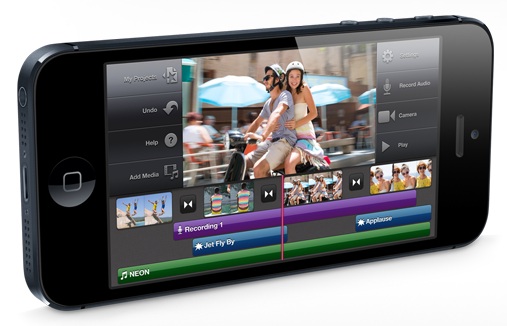
Apple introduces the thinnest, lightest, fastest and most powerful phone it has ever made, the iPhone 5, which will be released Sept. 21. If the previous lame iPhone 4S managed to pull strong sales, this sexier iPhone 5 with bigger screen and slimmer body should be able to do better. With the four-inch (10-centimeter) screen finally makes its appearance after months (or perhaps years) speculation, Apple literally sends Samsung running for its money.
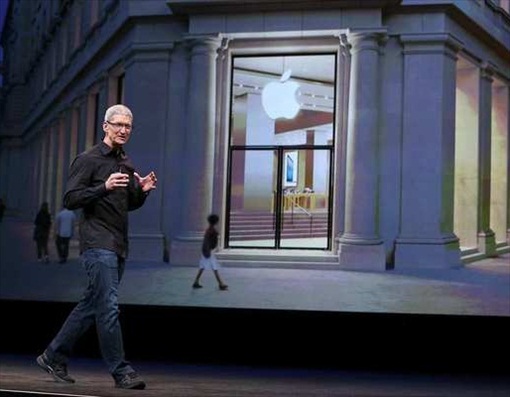
iPhone 5 - Apple CEO Tim Cook speaks
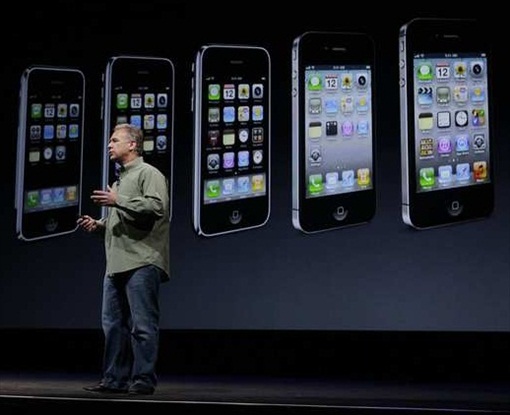
Now, before we talk about what is new in the latest iPhone 5, let’s see what are the bells and whistles that are not included. As a start, the much talked about NFC digital wallet is not available, probably due to infrastructure technology surrounding NFC is not read yet. When Nokia released its Lumia 820 and 920 that work with wireless charging, immediately Apple fans speculate and even demand that the coming iPhone 5 should come with this cool wireless charging capability. But it didn’t. Apples’ marketing SVP Phil Schiller explained that wireless charging isn’t all that great because you still have to plug somethinginto a wall.
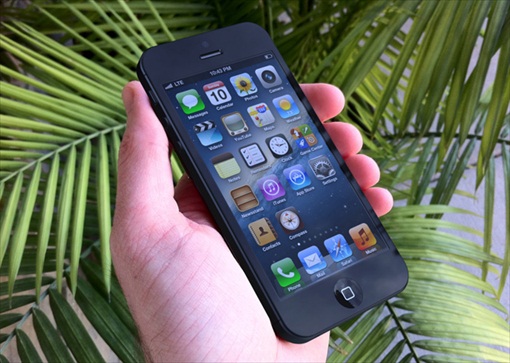
iPhone 5

[ 1 ] iPhone 5 Screen

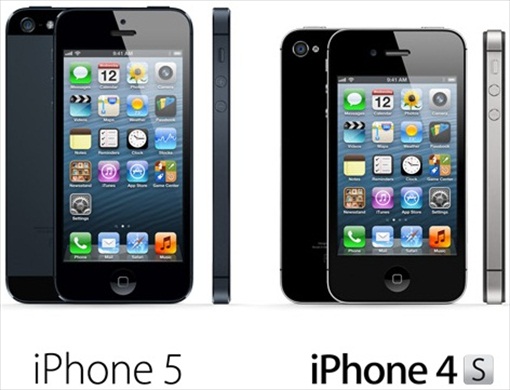
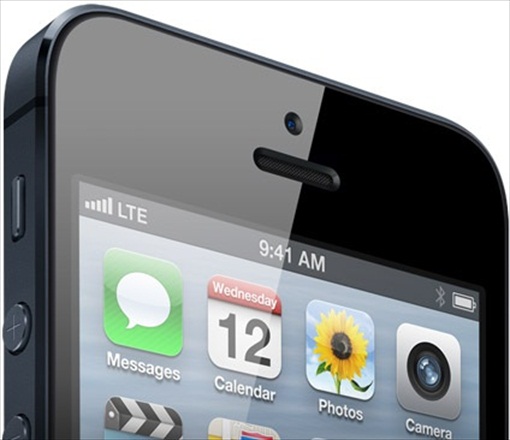
- this is not something new because it has been leaked to the public (intentionally?) but when it was revealed that the iPhone 5 will have a bigger screen than iPhone 4S, everyone was relieve nevertheless. It’s no brainer that Apple should give in to the demand from the prospect customers for a bigger screen. Actually the iPhone 5 is taller (by 9 millimeter) instead of wider (than iPhone 4S), with fifth row of icons on the home screen.
iPhone 5 - Screen
iPhone 5 - compare iPhone 4S
- while the iPhone 5 features 4-inch screen, it doesn’t compromise on the Retina display. In fact, the new phone gives you 18% more pixels through its 1136-by-640 resolution, maintaining 326 pixels per inch. Of course, developers need to do some work in order for their applications to fill-up the remaining extra spaces lest they wish their apps to appear letterboxed.

[ 2 ] iPhone 5 Size, Weight and Color

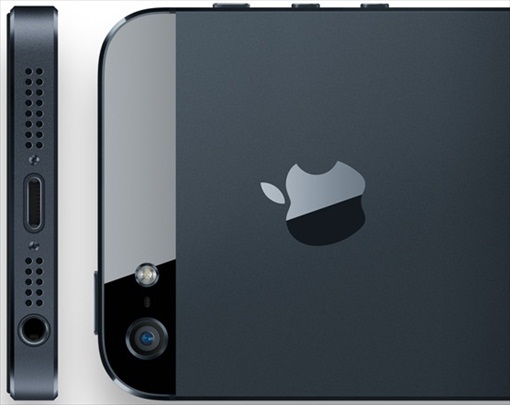
- size wise, iPhone 5 is 7.6mm thick and weighs 112g. It’s 20% lighter and 18% thinner and is made of aluminum and glass, which is kinda cool as it looks luxurious.
iPhone 5 - Size Weight Color
- this phone actually has a two-tone back – either “white and silver” or“black and slate”. According to Apple, the back of iPhone 5 is made of anodized 6000 series aluminum – the same material used in Apple notebooks – with inlays along the top and bottom made of ceramic glass (on the white and silver model) or pigmented glass (on the black and slate model).

[ 3 ] iPhone 5 Processor

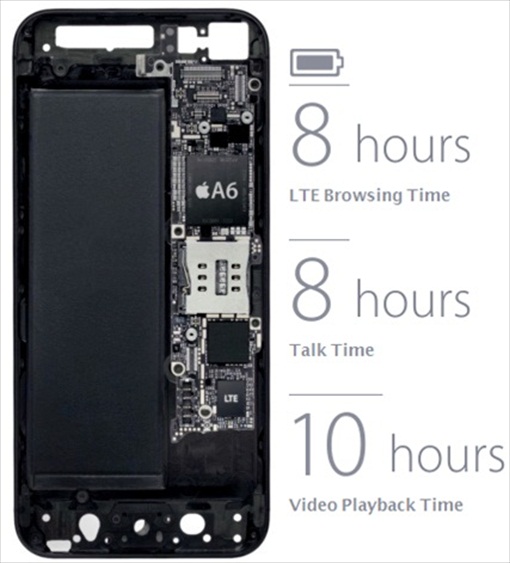
- as expected, the new iPhone is powered by new Apple A6 processor, with twice the CPU speed and twice the graphics power, based on the latest dual-core ARM Cortex-A15 CPU design.
iPhone 5 - A6 Chip and Battery Power
- Apple claims the processor is better on battery life than predecessor iPhone 4S – up to 8 hours of browsing on a cellular connection, up to 8 hours of talk time, and up to 10 hours of video playback time

[ 4 ] iPhone 5 Ultrafast 4G Network

- as speculated, iPhone 5 is a 4G LTE phone, supporting more networks over the world such as HSPA, HSPA+, and DC-HSDPA.
iPhone 5 - 4G LTE Network
- On the other hand, it’s Dual-band 802.11n wireless connectivity can accelerates Wi-Fi up to 150Mbps, provided your ISP provides such speed in the first place.

[ 5 ] iPhone 5 Nano-SIM

- if you think micro-SIM was small, Apple just announced an even smaller card – Nano-SIM. It is 40% smaller than the current micro-SIM format and measures just 12.3mm wide by 8.8mm high, and 0.67mm thick.
iPhone 5 - Nano-SIM
- now, if you think you can cut your existing micro-SIM into Nano-SIM, the same way you did it previously by cutting normal SIM to micro-SIM, bad news – you can’t simply because Nano-SIM is also 15% “thinner” than micro-SIM. And since you can’t reduce the SIM card thickness, you’re at the mercy of the telecom providers.

[ 6 ] iPhone 5 Cameras

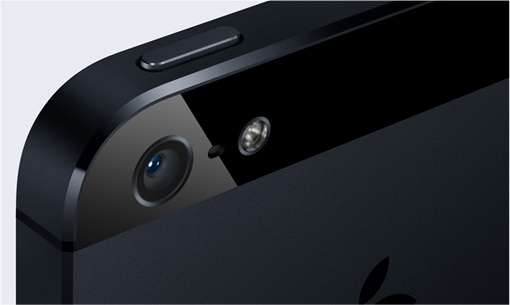
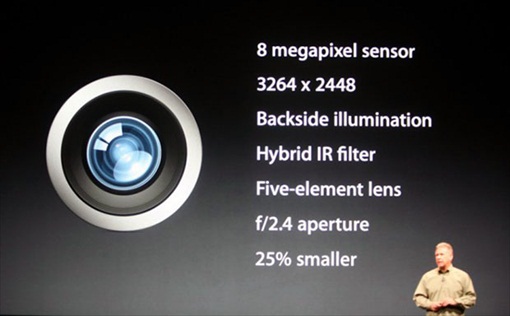
- the 8-megapixel iSight camera is almost the same as that in iPhone 4S, only smaller in size. Apple also claims improvement in 40% faster photo capture, better low-light performance, and improved noise reduction.
iPhone 5 - Cameras
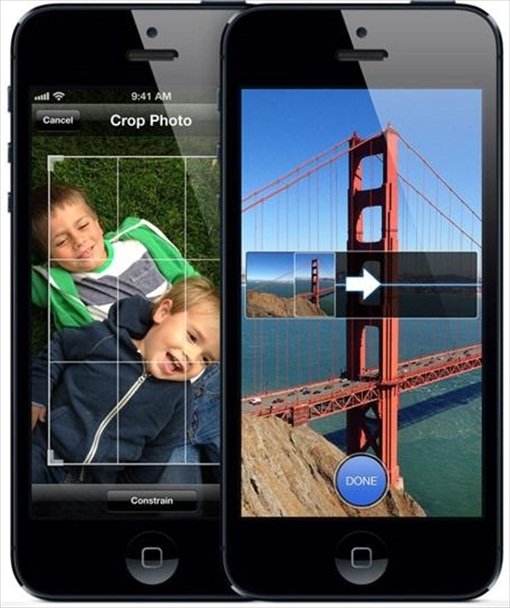
- besides new panorama feature allowing you to shoot up to an impressive 240 degrees, the other thing worth mentioning – now you can do facetime over a cellular connection if Wi-Fi isn’t available. Of course people have been using Skype or Yahoo Messenger to do “third-party facetime” prior to this.
iPhone 5 - Cameras - Panorama
iPhone 5 - Cameras - 2
- instead of VGA-resolution photos and video, iPhone 5 produces 1.2MP photos and 720p HD video.

[ 7 ] iPhone 5 Lightning Connector

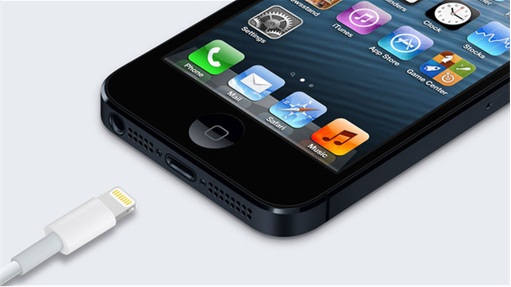
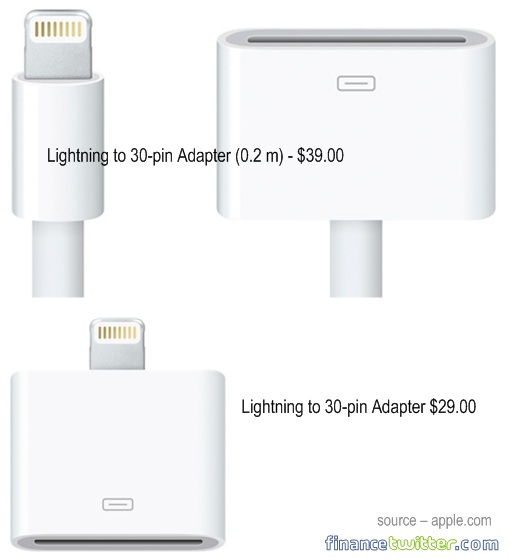
- Apple is introducing a new connector – Lightning connector – replacing 30-pin connector, supposedly more durable than the older 30-pin, this 80% smaller Lightning connector is reversible, meaning there’s no wrong way to plug in the cable.
iPhone 5 - Lightning Connector
iPhone 5 - Lightning Adapter
- naturally, the next question is what to do with the old 30-pin connector? You can still use it with a Lightning 30-pin Adapter, which is sold separately at an estimated price of a cool US$29 a piece. A full cable plus adapter costs US$39 but it’s only a matter of time before you can find a cheaper alternative from computer hardware shops.

[ 8 ] iPhone 5 features iOS-6

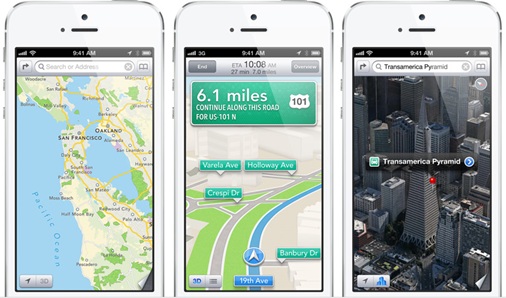
- historically with every new iPhone model, a new iOS would be introduced so there’s no difference with iPhone 5 as well. As speculated, iOS6 comes withApple’s new Maps app hence R.I.P Google’s Map. The new map features turn-by-turn navigation, real-time traffic info, interactive 3-D view and of course the assistance from Siri in helping you find your way.
iPhone 5 - iOS6
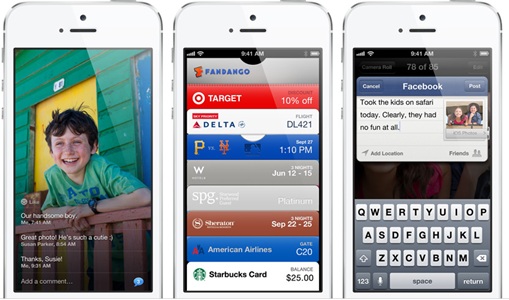
Facebook is now integrated into iOS-6 so you just need to sign-in once and you’re ready to share with the world. You can also share your photosinventories by simply select photos from the Photos app, tap the Share button and choose who you want to share your photos with. iOS-6 is available to download starting on 19 Sept, so mark your calendar.
iPhone 5 - iOS6 - 2
Passbook is another feature which literally means you have your boarding passes – movie tickets, retail coupons, loyalty cards, and more are all in one place. Another feature – when you decline an incoming call, you can instantlyreply with a text message or set a callback reminder. Hmm, but I want feature that allows me to block certain incoming numbers.

[ 9 ] iPhone 5 EarPods

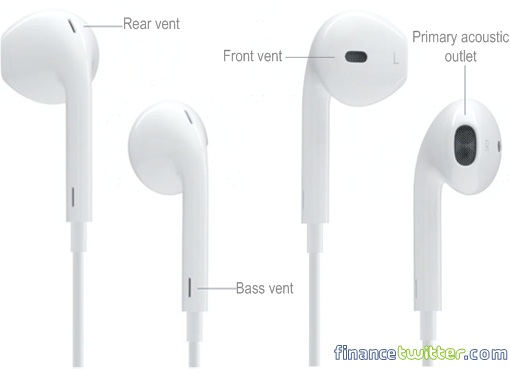
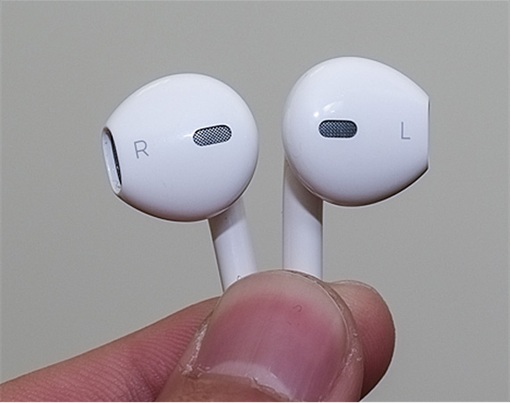
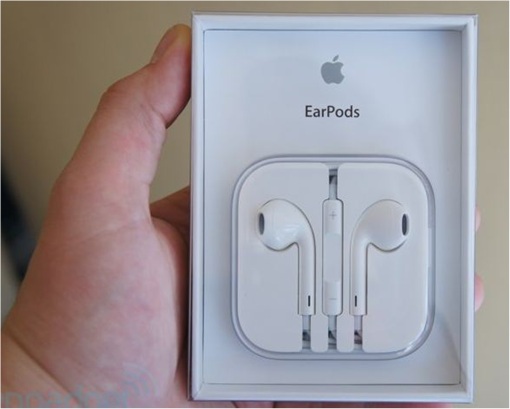
- together with the iPhone 5 introduction, Apple also introduces new headphone or earbud – EarPods, of which the company’s Industrial Design team had tested 124 prototypes on over 600 people.
iPhone 5 - EarPods
iPhone 5 - EarPods 2iPhone 5 - EarPods 3
- this new EarPods are supposed to provide a more natural fit, better durability and better sound quality (try to copy this Samsung, if you dare).

[ 10 ] iPhone 5 Pricing

iPhone 5 - Pricing
- in terms of pricing, iPhone 5 starts at $199 (16GB; $299 for 32GB and $399 for 64GB) in the US with a contract. As usual, the predecessor 16GB iPhone 4S is now priced at $99 (2-year contract) while an 8GB iPhone 4 is free. Since there’ no mention of 3GS, we assume it would be end of life.

[ 11 ] iPhone 5 Availability

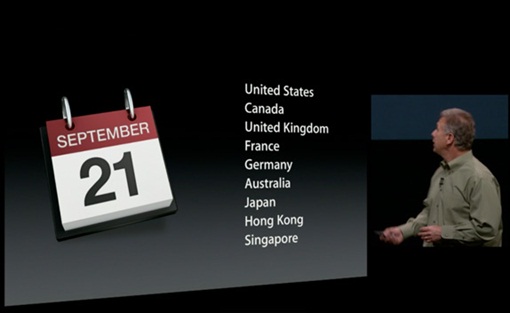
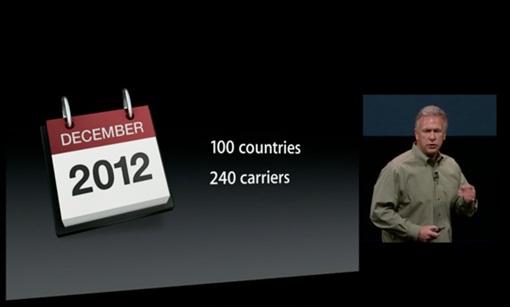
- the new phone release date is 21 September and Apple will start taking orders for the phone Friday (14 Sept) in the US, Canada, Britain, France, Germany, Australia, Hong Kong,  Singapore and Japan. In the UK, the handset will be available from the Apple Online Store, Apple’s retail stores, and through Everything Everywhere, Orange, O2, T-Mobile, Vodafone, 3 and select Apple Authorised Resellers.
iPhone5 - Sept21 - countriesiPhone5 - Sept28 - countriesiPhone5 - Dec2012 - countries
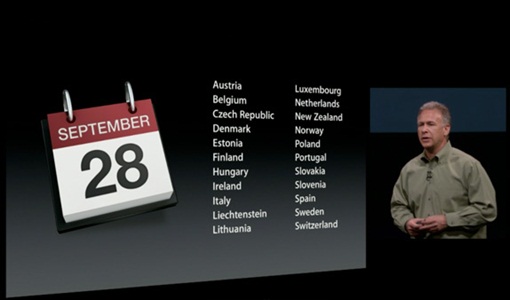
- iPhone 5 will be rolled out worldwide to 22 more countries on 28 September, including Austria, Belgium, Czech Republic, Denmark, Estonia, Finland, Hungary, Ireland, Italy, Liechtenstein, Lithuania, Luxembourg, Netherlands, New Zealand, Norway, Poland, Portugal, Slovakia, Slovenia, Spain, Sweden and Switzerland. Other countries will have to wait till end of the year.

FOREX 4U