Pages

Friday, June 17, 2011

New Perodua Myvi 2011 Review – Full Details and First Impressions


Click to enlarge
The Perodua Myvi first arrived on the scene in May 2005. With 487,400 units sold since then, the five-door hatchback has certainly been popular with the public – that it has been the country’s best-selling model for five years, from 2006 to 2010, states it all.
Of course, as good a run as it has been in terms of numbers, there’s only one way to ensure further success, so it’s time for a change, or at least a complete makeover for the car. The first-generation Myvi was facelifted in August 2008, but now a full revision is at hand with the arrival of the 2011 Myvi.
From a concept point of view, where the old car was defined as a multi-purpose compact (MPC) by the company, the second-gen vehicle is now tagged as an advance multi-purpose compact, or A-MPC if you will, which essentially translates into a refined compact car that continues its predecessor’s tradition of reliability, but with upgraded features and improved vehicle performance.
The incoming car soldiers on in 1.3-litre form – the promise of a 1.5-litre variant hasn’t come to light, unfortunately – and retains the usage of the same platform as before, though revision work has come about with the chassis.
The short of it is that Perodua says that the new Myvi contains more than mere aesthetic changes, and is really an evolution of the outgoing car, featuring a sleeker exterior, a more spacious and refined interior, enhanced safety features as well as improved NVH and better functionality and equipment levels.
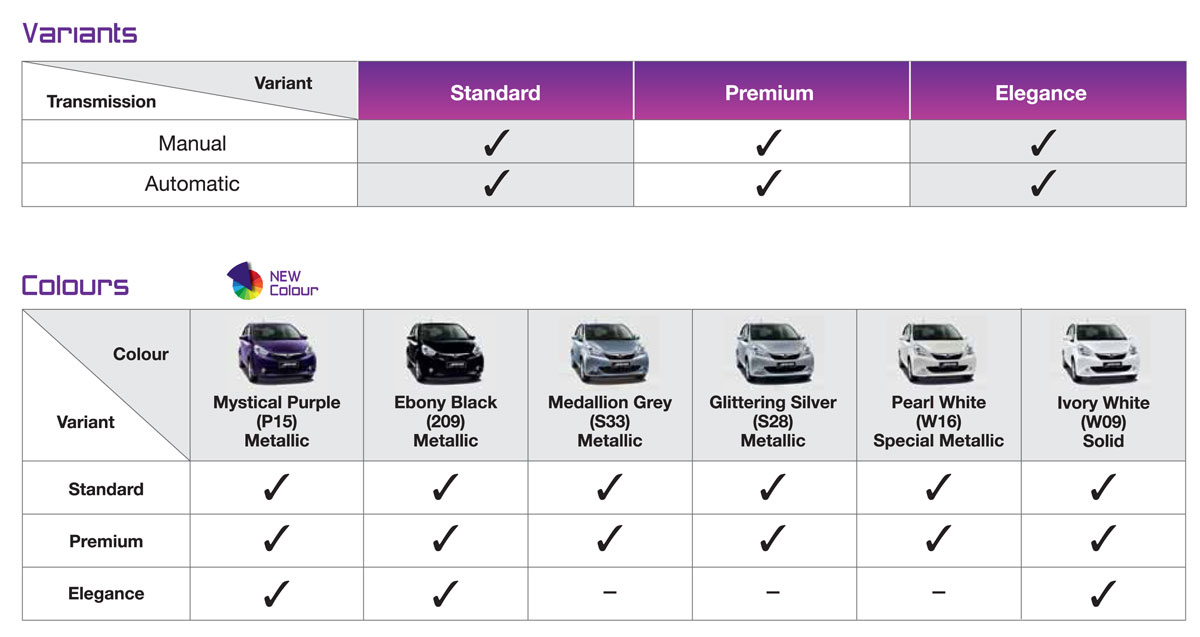
Let’s take a look at the changes in the new car, which is available in three variant forms – Standard, Premium and the top-of-the-line Elegance – at point of launch.
Read our full write-up after the jump.

Exterior

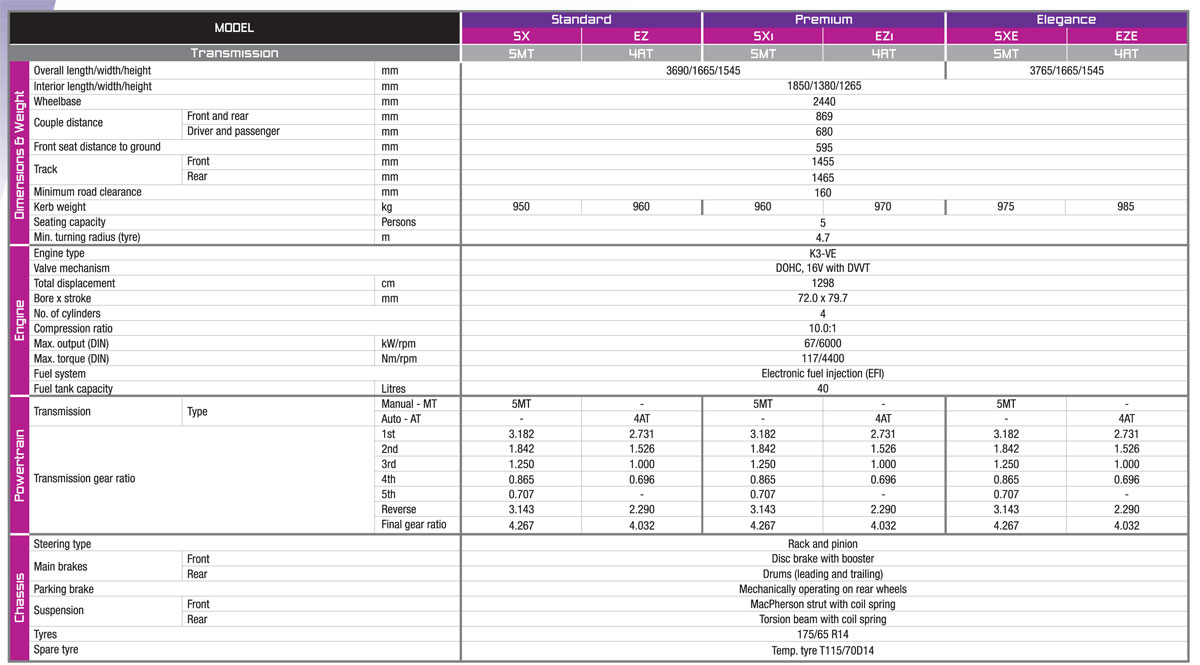
While the general profile of the car remains similar to the first-generation model (there’s no mistaking that the new car is a Myvi at first glance, after all), a number of styling cues have come about to offer a more refined and sharper-looking shape with this one, which tips the scale at 950 kg up to 985 kg, depending on variant and version.
Dimensions-wise, the 2011 Myvi has the same width as the old car, as well as the same track (front 1,455 mm, rear 1,465 mm) and wheelbase length (2,440 mm), but is shorter and slightly lower. Width remains the same at 1,665 mm, while the 3,690 mm length makes the new Myvi shorter by 60 mm compared to the old one (3,750 mm).

While this might suggest a reduction in cabin space, the interior length of the new car is actually up by 15 mm. Strangely enough, the length of the Elegance variant is listed at 3,765 mm, a good 75 mm more than the other two variants (presumably, this added acreage is the result of plastic bits). The height of the new car is 1,545 mm, just 5 mm lower than the older Myvi, the reduction coming about from a revised roof line.
At the front, the bonnet has been revised, offering a more prominent slope to enhance visual styling, and the front also features improved pedestrian collision safety aspects, in compliance with EC market requirements.

The visual effect is aided by a downward scoop that accentuates the new halogen-based projector headlamps the car wears. The new headlamps not only enhance the looks, but offer increased light coverage area and improved night visibility.
New to the Myvi is a front bumper lower lip, which the company tags as an “air spat,” to improve the aerodynamics and is also undoubtedly aimed at helping dress up the car further. Elsewhere, the new Myvi’s wheel arches have been reworked to offer the car a more muscular stance, and the front bumper design features a wide horizontal line to further bolster the presence of the car.

From the side, the car has more prominent character lines on the side panels to beef things up, and for the Premium and Elegance versions, the door centre pillar panels have been blacked out to add more dynamism to the side profile.

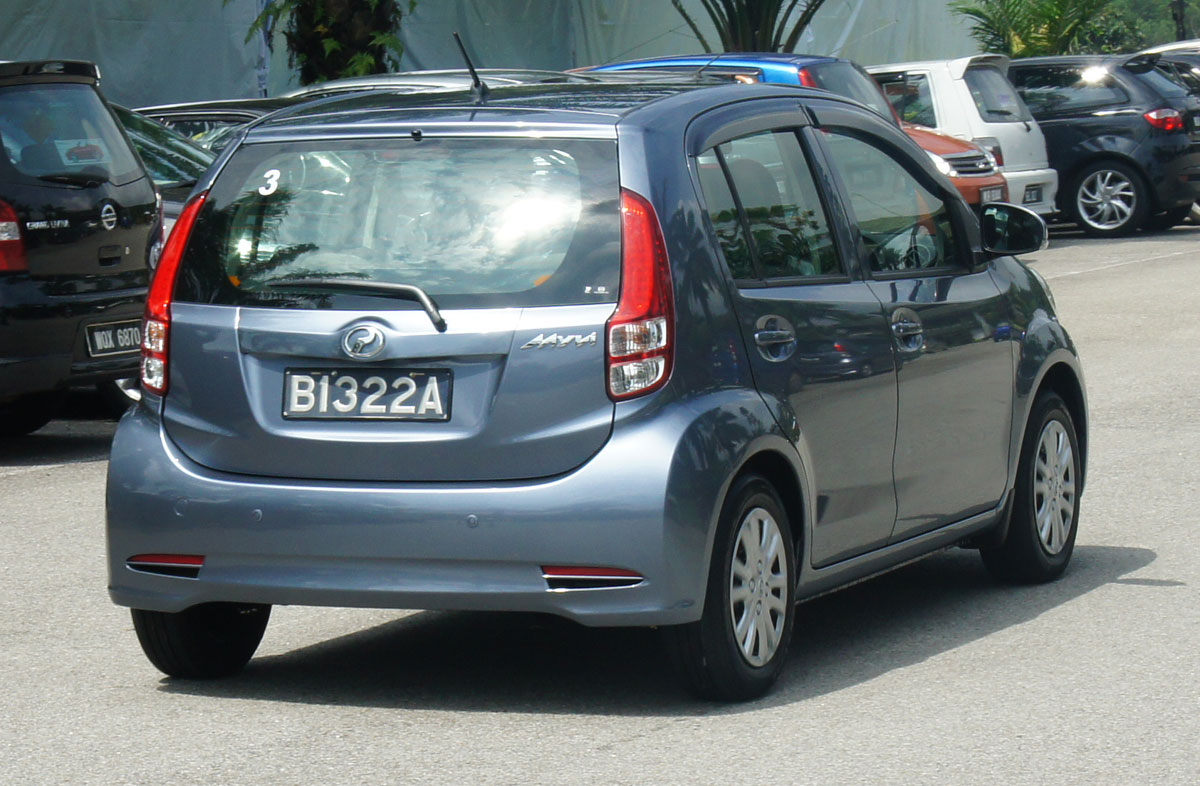
At the back, the tailgate now has more curves going about it, and visually doesn’t look so flat viewed from dead-on centre. In line with the changes, the rear lamps are a sleeker looking LED combination design.

Another new feature is air vents located on the new rear bumper, located under the reflectors. It’s not just for flash – the cut-outs are there to ease pressure build-up on the rear bumper to reduce flapping, something that’s visibly evident on the outgoing Myvi.
The use of UV protected glass is retained for the car; Perodua says this helps cut out UV rays by 91% compared to normal green glass and helps prevent the deterioration of cabin material. Granted, many are going to paste on a window tint film anyway, but it’s nice to know that it’s there.
Interior

Contrary to rumours, the new Myvi is not just a mere bumper change facelift, something which is evident in the cabin. The interior dimensions differ from the new car, and the dashboard is also all new. By the way, the new Myvi’s dashboard design is unique to Perodua, and is not shared with the Japanese market Toyota Passo.

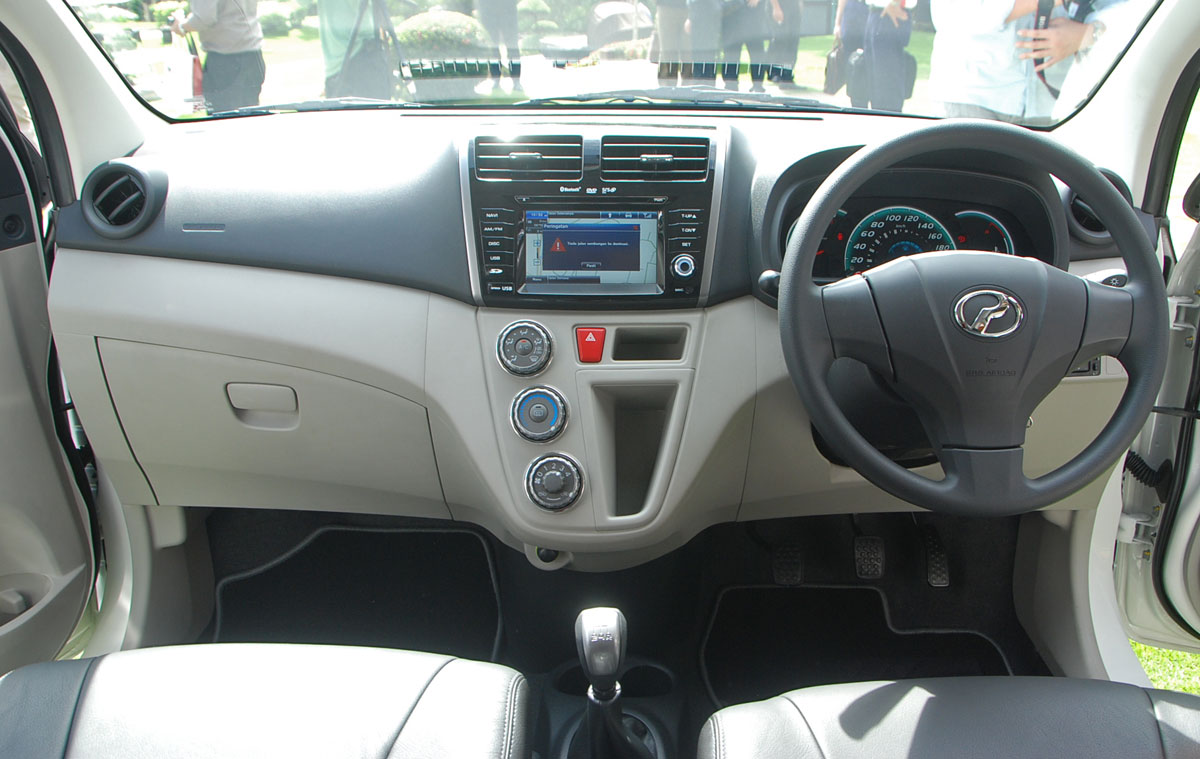
The biggest and most obvious change in the dash layout is the relocation of the automatic gear shifter to the centre console, freeing up space between the front seats for knick knacks. However, this only applies to the automatic version – manual transmission cars have the usual floor mounted gear lever, and the space on the centre console is filled by a cubby hole.

One of the highlights of the cabin is the new instrument panel, which features Toyota Camry-style meters. Sitting within the central speedo is a round screen that displays a digital fuel gauge, automatic gear position and information such as average fuel consumption and range. The latter isn’t even available on some D-segment cars, so it’s generous for Perodua to make it standard for all Myvi trim levels.
Whether with orange (Standard) or turqoise (Premium) illumination, this new instrument panel gives the Myvi an added sense of occasion and ups the level of “premiumness.” Also contributing to the “more premium feel” is the integrated head unit, which has large buttons and a clear layout. Compared to the old model, this new HU looks more feature rich. The sliver carbon fibre print may not be to all tastes though.

Opt for the Elegance spec and you’ll get a full colour 6-inch touch screen head unit with navigation. This is not offered anywhere else at this price point, and really adds to the Myvi’s showroom appeal. This HU comes in piano black trim, which looks nice but is easily smudged. For the Premium and Elegance, chrome trim is available on the shift knob and A/C controls.

The familiar “bottle cap” air-con controls are taken from the Alza, and is also similar to those on the pre-facelift Toyota Vios. But closer inspection reveal that the Perodua’s A/C has more functions compared to the two-mode A/C in the Vios. The steering wheel also looks very familiar, although checks show that it’s not from the Alza, JDM Passo or Vios.
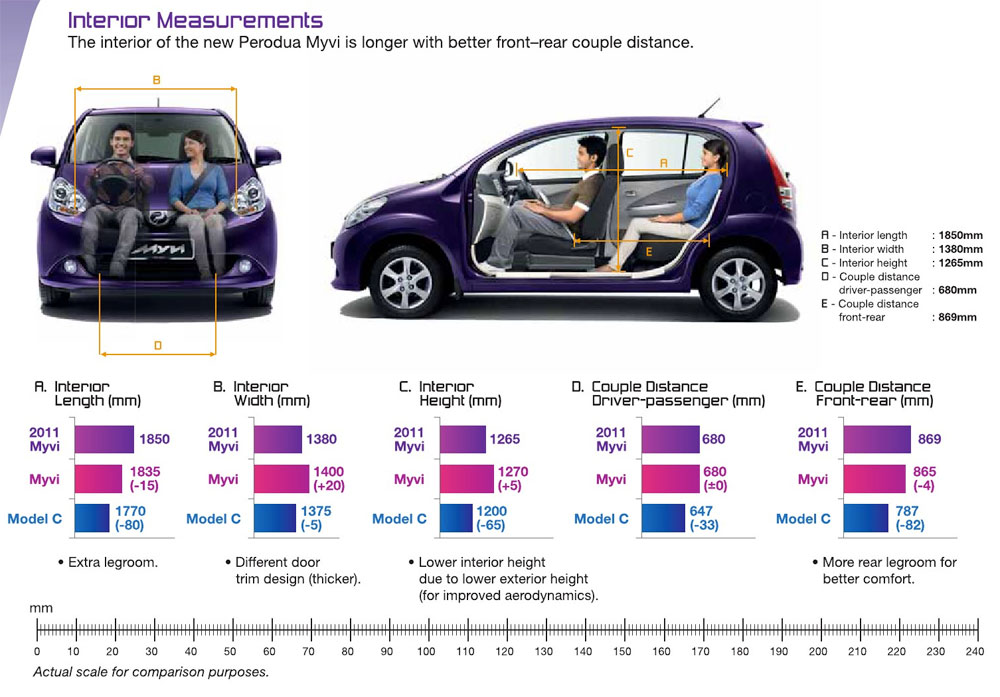
It’s more than just the dashboard, as the interior dimensions differ from the old car’s. The 1,850 mm interior length is 15 mm longer than before, while interior width is 20 mm less.
Click image above for an enlarged version
The latter is slightly narrower because of a new, thicker door trim. And in line with the lower overall height, interior height (measured at the B-pillar area, new roofed is more curved) is now lower by 5 mm.
The slightly altered interior dimensions don’t affect the Myvi’s well known cabin space and airiness. But rear passengers will notice a slight decrease in headroom due to the rounder edges of the new car.
Luggage

The new Perodua Myvi has 208 litres of boot space, which is actually 17 litres less than the Myvi it replaces that had 225 litres. This is because of increased couple distance (front to rear) and thicker padding for the rear seats.
With the rear seats folded, the new car’s enlarged boot space stands at 595 litres, which is less than the previous Myvi’s 630 litres. The margin is even bigger for the folded seat boot space because of the thicker door trim on the new car.
Equipment levels and features
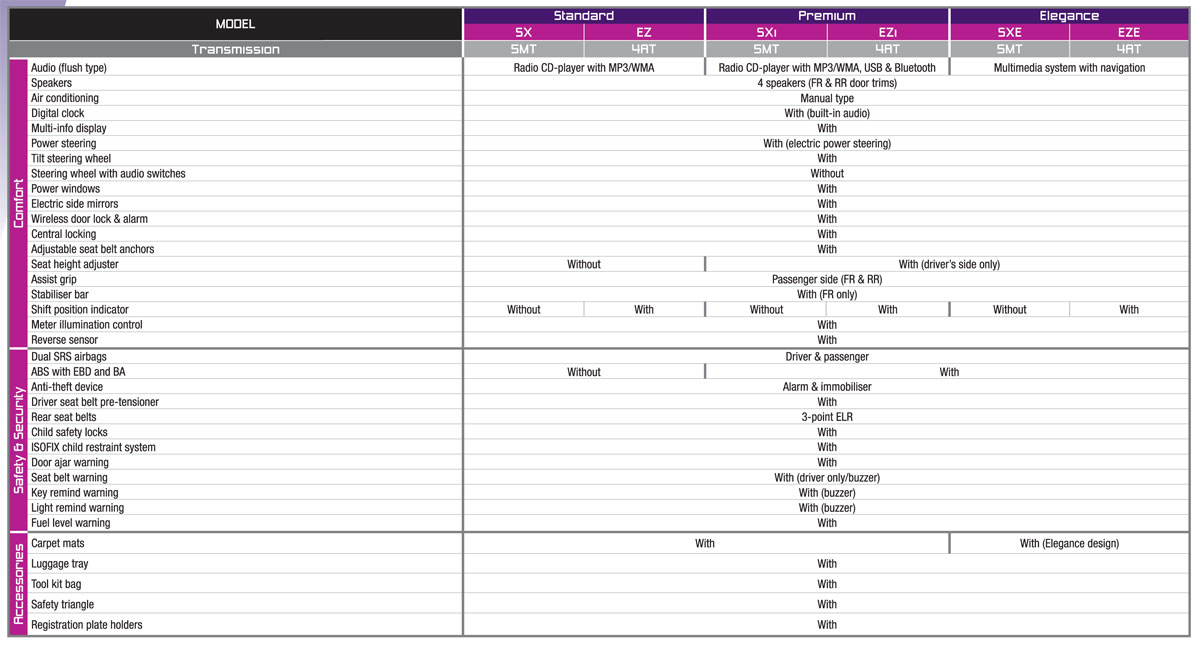
Click image above for an enlarged version
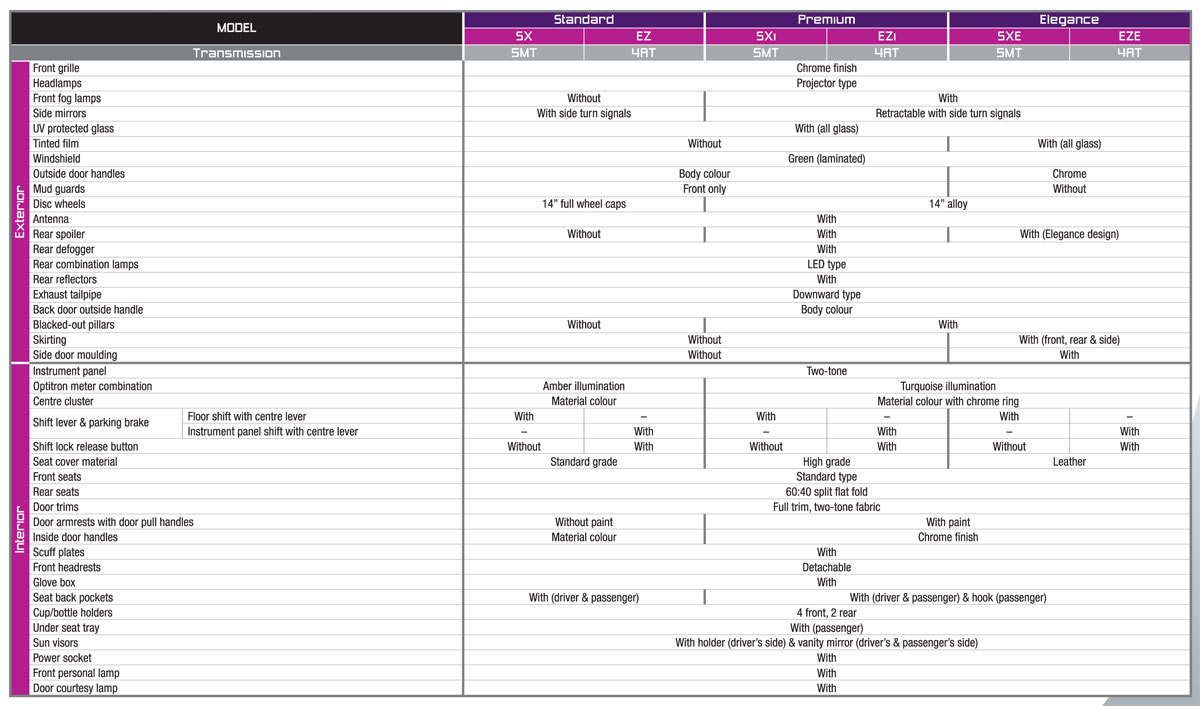
The three variants offer a total of six versions of the car, which retains the K3-VE 1.3 litre DVVT twin-cam mill – offering 90 hp at 6,000 rpm and 117 Nm at 4,400 rpm – throughout the range.
In Standard form, the car is available in SX five-speed manual and EZ four-speed auto guise, while Premium has the SXi manual and EZi auto, and the respective Elegance versions are the SXE and EZE.

Click image above for an enlarged version
The new Myvi has electric power steering featuring across the entire model range, and Perodua says that with the elimination of the need for the power steering pump has translated into some minor gain in the power output from the engine.
Meanwhile, noise and vibration performance is also improved over the old, with the inclusion of additional insulation on the engine hood, door trim, floor and roof areas.

Round-design fog lamps are to be found on the Premium and Elegance, which also get electric retractable side mirrors and a new 6-spoke 14-inch alloy wheel design. The Standard variant gets 14-inch steel wheels with wheel covers, and the car rides on 175/65 series rubbers.
Inside, the rear 60:40 split configuration seats are extendable by pulling the seat cushion forward over the leg space, offering a flat surface that one can sleep on (well, you can imagine the fun to be had with this one). Alternatively, they can be folded down in full flat mode for cargo purposes. Elsewhere, items such as a shopping hook (or teh tarik holder, if you will) in the Premium and Elegance variants offer up to 3 kg of carrying load.

Click image above for an enlarged version
The seats themselves feature padding and shoulder areas that have been reshaped to provide extra comfort, and the new seat fabric feels softer, the company states – the Standard gets standard grade fabric, while the Premium gets a high grade one.
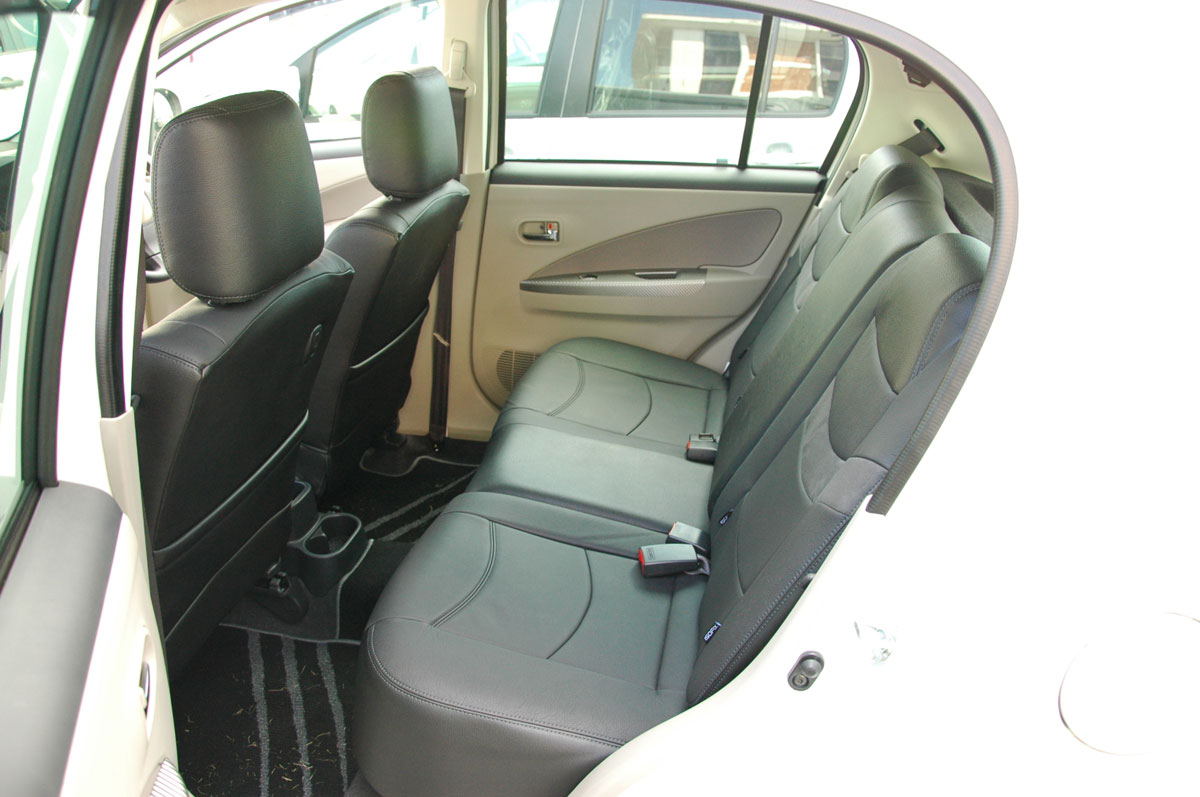
Safety-wise, all variants get dual SRS airbags, which is a welcome move, and the driver’s side gets a seat belt pre-tensioner force limiter. Three-point seatbelts are now to be found for all three rear occupants, and both Premium and Elegance versions come with ABS and EBD and brake assist, but a big plus is the inclusion of ISOFIX mounts on all models for the easy and secure installation of child seats. Something like Vehicle Stability Assist (VSA) would have been welcome, but we were told that the reason for its omission is because of the front disc/rear drum brake configuration and the absence of four-wheel ABS.
The Elegance variant features a bodykit consisting of full skirting, side moulding and spoiler, as well as chrome door handles, Elegance badging and tint film compliant with JPJ regulations – those wishing to add the body kit will be pleased to hear that it can be purchased as an accessory in a few months time. Elsewhere, there are also leather seats and Elegance carpet mats, aside from the biggie, which is the touchscreen multimedia four-speaker system with navigation.
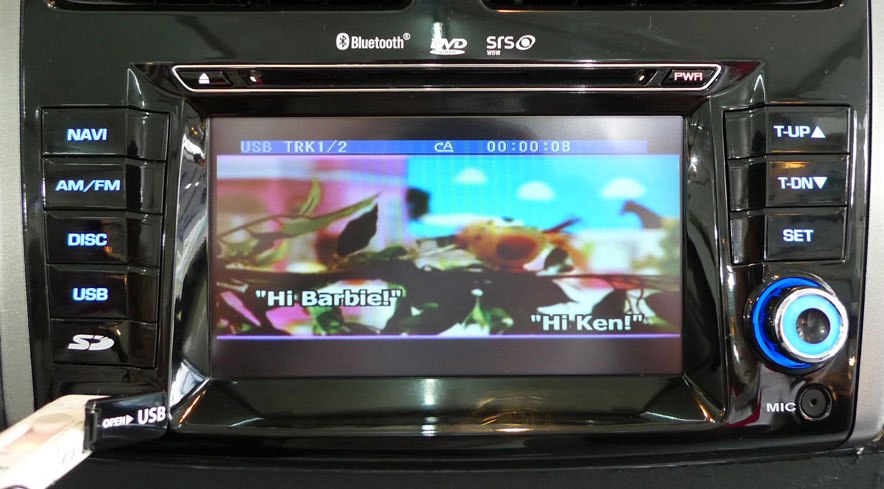
For this one, there’s USB and SD card support as well as Bluetooth capability for both phone and audio, and the DVD-based system also offers MP3/WMA playback. Meanwhile, the Standard gets a radio/CD player four-speaker audio system with MP3/WMA capability, and the Premium comes with the same, but with USB and Bluetooth added in,
The Myvi is available in six colours, five of these being metallic – Ebony Black, Glittering Silver, Medallion Grey, Pearl White and a new shade called Mystical Purple – and an Ivory White solid shade.
Brief Driving Impressions

We got a very brief spin in the Myvi at the car’s preview. However, bear in mind that it was just a small loop of just 4.4 km in Cyberjaya, just enough to exit Cyberview and accelerate to highway speed, before making a u-turn home. We will need an extended drive for a more concrete view, but here’s what we have for now.
The driving experience isn’t very different from what we remember of the old Myvi. The engine can be heard quite loudly in the cabin, but we can also say the same for the RM110k Honda Jazz, so it’s no big flaw. Some in our office noticed improved noise insulation over the previous model, though.

The best-selling car in Malaysia is as easy to drive as ever. Visibility is excellent and all the controls are light and effortless. The new EPS steering isn’t the last word in feel and precision, but fulfills its “easy” brief well. Once again, we’ll need a longer stint, but the helm feels a bit less vague than before.
The suspension is new, with retuned spring and damper rates (front dampers by Kayaba, rear dampers by APM) for a firmer ride and better control. Without a back-to-back drive, our short loop didn’t offer a chance to test this out.

What we all agreed on is the new cabin, which is offers a more premium feel than the basic old dash. The instruments and head unit are good to look at and work well. In the back seat, the reduced headroom is apparent. It’s still adequate, but no longer generous, as our demo pic shows. The “frame” of the roof is now nearer to the passenger’s head when the seat back is in the most reclined position.
Remember that the new curved roofline helps aerodynamics, which in turn improves acceleration and fuel consumption. The new Myvi is claimed to have 4% better fuel consumption and 15% better for the auto. Besides being more slippery in terms of body aerodynamics, the use of EPS and lower rolling resistance tyres contributes to the cause.
Click to enlarge
Click to enlarge
In the media preview, the various test units wore different rubber from Silverstone, Goodyear and Continental – we’re not sure which brand makes it to the showroom.
By the way, Perodua has collected 10,000 orders for the new Myvi since 4th June, and exports to Indonesia starts next month. Here are the prices of all variants:
Variant1.3 Standard1.3 Premium1.3 Elegance
ColourSX (MT)EZ (AT)SXi (MT)EZi (AT)SXE (MT)EZE (AT)
SolidRM43,900RM46,900RM46,900RM49,900RM53,900RM56,900
MetallicRM44,400RM47,400RM47,400RM50,400RM54,400RM57,400
Special MetallicRM44,800RM47,800RM47,700RM50,800  

Click to enlarge

Source: Paultan

Thursday, June 16, 2011

Perodua 2011 New MyVi Price from RM43,900 to RM57,400


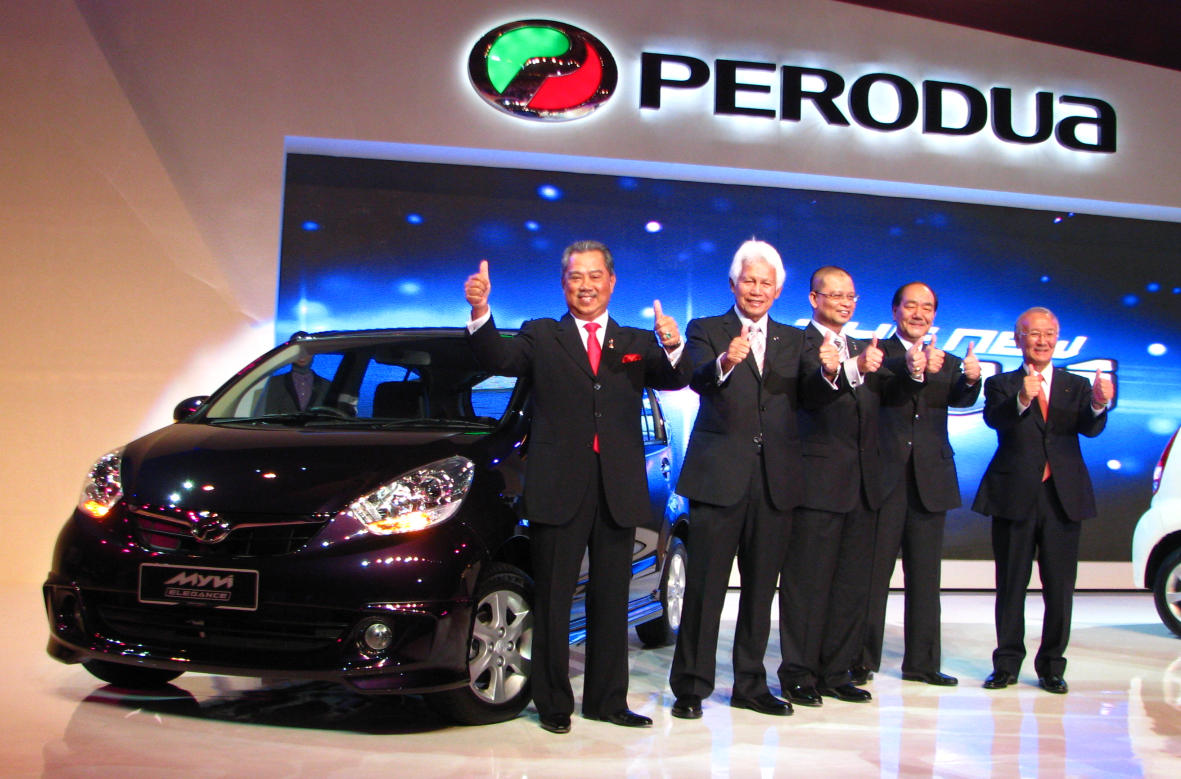
KUALA LUMPUR: Perusahaan Otomobil Kedua Sdn Bhd (Perodua) unveiled - the new MyVi -- an upgraded version of the best seller on Thursday night, June 16 and prices range from RM43,900 to RM57,400.
The new model comes in three variants -- standard, premium and elegance – and will be on display at all 178 Perodua sales and selected service outlets nationwide.

Perodua managing director Datuk Aminar Rashid Salleh said the new MyVi is more than mere aesthetic improvement to the design of the successful MyVi model which was launched in May 2005.
He said it was an improved variant in terms of both looks and functionality and it has received about 10,000 orders since booking opened on June 4.

The second national carmaker expects to sell about 8,500 units monthly. The price is from RM43,900 for the standard manual transmission and RM57,400 for the elegance automatic transmission on-the-road.
The new models come in with a new colour ; mystical purple which is available for all variants. Other colors include ebony black, medallion gray, glittering silver, pearl white and ivory white.

Aminar Rashid also said Perodua plans to export the new MyVi units to Indonesia this month, starting with 500 cars, under the Daihatsu Sirion badge

"This will be the real test of our seriousness in expanding our export market. For the first batch, we will export some 500 units to Indonesia," he said.

Malaysia 's Government Overspending ???


JUST in the past few days, Malaysians were given a head-scratching example on how taxpayer money was being used.
When it was revealed that RM1.4mil was spent by the Domestic Trade, Co-operatives and Consumerism Ministry on a price comparison website, many argued the price paid to get that website up and running was too high, given its simplistic nature.
Such things have now culminated in the annual reading, and eventually passing of the Supplementary Supply Bill 2011 where the Government will reach into the Consolidated Fund to draw down a further RM13.17bil to add to the budget for 2011.
Under Budget 2011, the Government is planning to spend RM162.8bil as operating expenditure and when adding the extra RM13bil the Government now wants to spend, operating expenditure is forecast to rise to RM176bil.
Under the Bill, an extra RM5.6bil was meant to go toward providing fuel subsidies, which would naturally go up, considering that under Budget 2011 the Government had forecast fuel subsidies to cost RM10bil. But with the price of fuel where it is now, that cost has naturally gone up.
The Bill also saw a number of ministries receive additional allocation ranging from RM5mil to RM1.8bil.
Questions will be asked whether the additional expenditure will lead to a bigger budget deficit, which as of now is forecast to hit 5.4% of gross domestic product this year.
It's not a guarantee that will happen as revenue collection, in years where the economy has been healthy, has been higher than earlier estimated. Revenue collection under Budget 2011 is estimated at RM165.8bil.
The more-than-expected revenue will allow the Government to spend more but the process of taking more money out of the kitty to meet uncounted expenditure is not new and has been going on for years. The problem is that it does not seem to be getting any smaller.
Some have hypothesised that one reason for the additional increase is down to inflation. Costs have gone up and in the current period of higher inflation, what might have been planned earlier might cost more now.
The latest salary increase for teachers might also been a factor in the Supplementary Bill as the Education Ministry, after the Finance Ministry, was the second largest recipient of additional monies amounting to RM1.8bil.
The Government is now looking to rationalise the public service as it too knows that the growth in expenditure caused by the size of the civil service over the years has been tremendous and much of it goes towards paying salaries and pensions.
Should the growth in salaries, pensions and grants not be cut, then the fiscal burden which the Government has endured for more than 10 years will continue to snowball.
Pressure on the need to check expenses also will be greater in a couple of years when Petroliam Nasional Bhd (Petronas) switches its dividend payment to the Government from a flat RM30bil a year to where at least 30% of the company's net profit will be paid as dividend.
This means that should Petronas' annual net profit dip below RM100bil, the dividend the Government will receive will drop. Petronas reported a net profit of RM63bil last financial year.
Worst still, should oil prices retrace significantly back during any future recession, then oil revenue would certainly also fall.

Wednesday, June 15, 2011

RM1.8 million spent on Facebook pages by Tourism Ministry Malaysia


KUALA LUMPUR, June 14 — A whopping RM1,758,432 was spent on developing six Facebook pages to promote Malaysian tourism, the Tourism Ministry said today.
Deputy Tourism Minister James Dawos Mamit said this today in reply to a question from Anthony Loke (Rasah-DAP).
Each Facebook page cost RM293,072 — Cuti-Cuti 1 Malaysia, Citrawarna 1Malaysia, Karnival Jualan Mega 1 Malaysia, Festival Pelancongan Seni Kontemporari 1 Malaysia, Kempen 1 Malaysia Bersih and Fabulous Food 1 Malaysia.

The Citrawarna 1 Malaysia page has so far attracted 20,292 Facebook fans since it was launched on May 21.
Mamit said that the RM1.8 million included costs for designing, flash programming and coding, testing and debugging, uploading and launching the application, system server deployment and campaign management.
“You need RM1.8 million to run Facebook pages and applications? A six-year-old can start a Facebook page.
“If Datuk Seri Ng Yen Yen has problems getting people to help start Facebook pages, DAP headquarters can help her out, we have people who can develop these things at no cost,” Loke told reporters later at a press conference.
Loke said that unless Ng explained the reasons behind the “exorbitant” costs for the “social media branding” exercise by her ministry, he would lodge a report to the Malaysian Anti-Crimes Commission (MACC).

Easy Payment Plans – June 2011


Easy Payment Plans allow you to spend first and pay in installment based on the purchase or spent amount.
There are few ways to apply for EPP.
  1. Apply directly at selected merchant during your purchase
  2. Call card issuer and furnish details of the purchase and number of installments that you want to make. Usually this must be done before the next Statement Date.
  3. Deal with company/agent that provides service on EPP to settle credit card outstanding (not advisable)
Table below shown Easy-Payment Plan that currently offered by several card issuers or banks (for item 1 & 2 above).
Click picture to enlarge

Is It Safe to Bank Online?


Last week's security breach at Citibank was just the latest in a string of incidents that have rattled consumers: Sony, Lockheed Martin, and iTunes are also among recent high-profile targets. With such big names falling victim to hackers, is it still safe to bank online?
The answer, according to top security experts, is a qualified "yes." Using the Internet to bank, buy music, or shop is still as safe or safer than visiting brick-and-mortar locations, as long as consumers take precautions and know what to do if they notice any suspicious activity. In fact, the overall trend is a reassuring one: 2010 actually saw fewer records breached than the previous year due to new infrastructure in place, says Julie Conroy McNelley, senior fraud and risk analyst at research firm Aite Group. Today, she adds, "banks have some of the most sophisticated mechanisms in place."
As long as consumers take a few basic steps (explained below) to help protect their information, security experts agree that online banking remains safe. That's a good thing, since it's almost impossible for consumers to avoid sharing personal data online if they want to participate in 21st-century life, from Facebookto online sales to paying bills. Plus, as McNelley adds, many breaches involve databases of card numbers that exist regardless of how cardholders use their accounts.
Much of online security is out of consumers' hands altogether. "It's actually extremely difficult to know how secure any bank's information-handling is," says Geoff Webb, executive at data protection firm Credant Technologies. Banks often don't share much about their security techniques, since they don't want to tip off criminals on how best to attack them. Whether they talk about it or not, financial firms should be encrypting data, segregating credit card information from other types of data, and making web applications as secure as possible. Regular training of employees is also key, he adds.
In addition to doing what they can to protect themselves on their own, consumers can talk to their representatives in Congress to push for bigger changes, Webb says. The government is becoming increasingly involved in driving the security of banks and other organizations, Webb says. In fact, the Commerce Department recently urged online companies to improve their own security, and President Obama proposed new cybersecurity legislation in May.
Here are 10 steps consumers to take to make sure their information is safe:
1. Don't talk to cyber-strangers, and don't click on hyperlinks within emails from strangers. "That's the easiest way to download malware to your computer," says McNelley. Even if an email looks like it's from a company you know, such as your bank, go directly to the bank's website and log in there instead of clicking on the embedded link, and never open attachments from strangers (or even suspicious-looking ones from friends, who may have been hacked themselves). Sometimes hackers will set up fake sites that look like real sites to capture victims' information, a method referred to as phishing.
"A financial institution will never contact you via email asking you to verify your funds, request your username or password, or any other sensitive information," says Stephen Sims, senior instructor at the SANS Institute, which educates security professionals.
2. Treat your smartphone like the computer it is. Downloaded apps can contain malicious codes, warns McNelley. "You have no idea who created that app, and very little code-checking goes on," she says. If you're going to download apps, she suggests avoiding or minimizing the financial transactions you make with the smartphone. "Mobile phones are really tiny computers, but most consumers don't treat them as such or get anti-virus software for their smartphone," she adds.
Meanwhile, be sure antivirus software on laptops and desktops is up to date. "Many compromises are a result of keystroke-logging software that is illicitly installed on a user's system, capturing usernames and passwords," says Sims.
3. Treat social networks like dark street corners. You never know who's lurking among your friends and acquaintances. Hackers have targeted Gmail, Facebook, and LinkedIn, and users of those sites should be especially wary of clicking on embedded links, even those "recommended" by friends. Hackers also send emails that appear to be from social networking sites but are, in fact, fake emails designed to capture personal information. Again, users should avoid clicking on links embedded in emails.
4. Use the Net to your own advantage. If you bank online, you don't have to wait until the end of the month to check your statement. You can log in anytime and make sure nothing is amiss. An errant charge is often one of the first signs of identity theft, so check statements carefully and alert your bank immediately of any problems.
5. Get free help. Many credit card issuers offer free and automatic identify-theft protection to customers. (That's one advantage credit cards have over debit cards.) If you see erroneous charges on your statement, call your credit card company, which should investigate on your behalf. The law requires credit card companies to dispute erroneous charges. For most people, paying a monthly fee for extra monitoring services is unnecessary. (Once a year, consumers can get their credit report free of charge through annualcreditreport.com.)
6. Think of a new word. Consumers are tasked with remembering dozens of passwords for various retailers, banks, and accounts, making it almost impossible to remember them all, especially since they often include mixes of numbers and letters. Keep careful track of your passwords in a secure document, rely on mnemonic devices to boost your memory, or come up with some other clever strategy--but don't stick with simple passwords that are easy for strangers to guess. Also, change your passwords on a regular basis.
7. Never, ever give your Social Security number to anyone online. If a site asks for it during the checkout process, it's probably a scam site.
8. Shred or safely store financial mail. Bank statements, investment documents, and other financial paperwork can give thieves clues about account numbers, Social Security numbers, and other personal information. Destroying documents with a cross-cut shredder works, but you can make it easier on yourself (and the environment) by limiting your paper trail wherever possible. Shifting to online banking and document storage can reduce your chances of falling victim to a dumpster diver.
9. Fight back quickly. If you are hacked, step one is calling your bank, says McNelley. That's because banks have sophisticated systems in place that can immediately begin closely monitoring your account for signs of identity theft. They can also and shut down and replace any accounts if necessary. In fact, banks are often the first to notice something amiss, even before the victim.
As long as consumers report fraud in a timely manner, the law limits their liability to between $50 and $500, says Sims.
10. Trust your gut. "You often hear, after consumers used an ATM with a skimming device, they had a bad feeling about it. If you do have that feeling, listen to it," says McNelley, and remove yourself from the situation.
Taking these simple steps is like remembering to lock your door at night, or turn on your alarm system. Says McNelley, "Bad guys go for the house that's unprotected. If you take the basic measures, then generally you have less risk about getting compromised."

Tuesday, June 14, 2011

2011 The Best-Paid Celebrities Under 30


Lady Gaga ranked first on Forbes' annual list of the best-paid celebrities under 30.Andrew H. Walker/Getty ImagesFame favors the young. If you doubt that, just take a look at the singers, movie stars, and athletes on our annual list of the best-paid celebrities under 30.

These guys haven't gotten rich through decades of careful, prudent investing, like some of the top members of our Forbes 400. But they have sweated and spent a lot of sleepless nights honing and promoting their talents. That hard work helped these 20 young stars bring in a total of $690 million between May 2010 and May 2011.
The youngest star on our list is Justin Bieber. In his meteoric rise to fame, the 17-year-old crooner skipped the dues-paying drudgery of touring clubs and small venues that many artists go through to work their way up. Instead, at a time when most teens are worrying about who to invite to prom, he's been touring the world and starring in a hit concert documentary. Bieber ranks second on our list with $53 million in earnings over the past 12 months. That money, plus his incredible fame, helped him debut in third place on our annual Celebrity 100 list, which measures wealth and fame.
Bieber is one of seven musicians who make our list. A world tour of arenas can be incredibly lucrative and almost all of our music stars had big tours this year. Lady Gaga, who ranks first on our list, grossed $170 million from 137 shows in 22 countries. Gaga is, of course, no slouch when it comes to music sales. Between May 2010 and May 2011 (before her latest album, Born This Way, dropped) she sold an estimated 15 million albums worldwide. We estimate that over that time Gaga earned $90 million. She ranked first on our Celebrity 100 list this year because of her earnings power and her ability to always attract attention, whether shes wearing a meat dress or arriving on stage in an egg.
Rihanna makes our list of the top earners under 30 in 10th place, although she just failed to make the cut for the Celebrity 100. The singer earned an estimated $29 million between May 2010 and May 2011 thanks to a tour, great album sales, and endorsements with brands like Fuze Drinks and Venus Razors. Shes also becoming increasingly apt at attracting attention. Rihanna is the latest musician to kiss Brittney Spears at an awards show. The two locked lips at the recent Billboard Awards.
Nine of the top-earning young celebrities are athletes. In third place is LeBron James, who brought in $48 million over the 12-month period. James' reputation may have taken a hit when he moved from the Cleveland Cavaliers to the Miami Heat, but it didn't hurt his earning power. His jersey was the NBA's top seller and he has the No. 1 basketball shoe on the market.
Tennis player Roger Federer ranks fourth with $47 million in earnings. He may no longer be No. 1 on the court, with Rafael Nadal and Novak Djokovic passing him in the ATP rankings, but he still commands the most impressive endorsement portfolio in all of sports, with 10 major deals with the likes of Nike, Rolex, and Wilson.
Representing Hollywood are "Twilight" stars Robert Pattinson and Kristen Stewart, who tie for 15th place with $20 million each. Their earning power should stay strong at least for the next year as the "Twilight" franchise winds down with two "Breaking Dawn" movies.

Here's the Top 10 Highest Paid Celebrities Under 30

1. Lady Gaga, 25 (US$90 million)
2. Justin Bieber, 17 (US$53 million)
3. LeBron James,26 (US$48 million)
4. Roger Federer, 29 (US$47 million)
5. Taylor Swift, 21 (US$45 million)
6. Katy Perry, 26 (US$44 million)
7. Cristiano Ronaldo, 26 (US$38 million)
8. Beyonce, 29 (US$35 million)
9. Lionel Messi, 23 (US$32 million)
10. Rafael Nadal, 25 (US$31 million)

FOREX 4U