Market now hit our targets as well as at the tail-end of our earlier envisaged peak in early 2Q. Thus, time to reevaluate the risk-reward profile for the next course of action.
True to our view that the market is expected to peak in early 2Q and our analysis of risks and rewards, we believe that the tide has turned. We believe that there are limited catalysts to propel the FBM KLCI significantly above our revised year-end target of 1,580 and our earlier technical target of 1,600. However, re-emergence of uncertainties in EU coupled with concerns about slowdown in China, our fiscal position and general election as well as negative technical readings suggest that there could be more downside risks vis-a-vis potential returns.
While we believe there are more downside risks vis-a-vis upside potential, we also believe that equity markets as a whole is not likely to revisit the fear level experienced in 2011. This is premised on higher liquidity level (after the massive injections in Dec 11) and the correction in 2011 (though seems large in quantum) was just short of the Fibonacci retracement level of 38.2% given that the market was on a slightly more than two years of rally. Coupled with recent changes to our forecasts (especially on Tenaga) and consensus forecasts, we have raised our year-end target slightly to 1,580 (based on 14x 2013 earnings) from 1,555 (13x).
KUALA LUMPUR: Malaysia's national debt at the end of last year stood at RM257.2 billion or 30.2 per cent of Gross Domestic Product (GDP), the Dewan Negara was told today.
Deputy Finance Minister Senator Datuk Donald Lim Siang Chai said the country's national debt or external debt was debt borne by the country following loans obtained by the government and private sector from overseas sources.
"It comprises the external debt of the Federal Government, non-financial public enterprises and private sector," he said in reply to Senator Datuk Paul Kong Sing Chu and Senator Datuk Abdul Rahman Bakar.
Lim said the Federal Government's total debt was RM456.1 billion or 53.5 per cent of GDP.
"Of the total, RM438 billion or 96 per cent was domestic debt while the balance RM18.1 billion or four per cent was external debt.
"The low external debt was in tandem with the government's policy to give priority to domestic borrowing as the market had high liquidity, the cost of borrowing was lower, and to minimise foreign exchange risk," he said.
Lim said the Federal Government's domestic debt sources were Treasury Bills, Investment Certificates, Government Securities, the Housing Loans Fund, issuance of Sukuk Simpanan Rakyat and Sukuk 1Malaysia.
He said the holders of such intruments comprised financial institutions, insurance companies and institutions like Employees Provident Fund and Social Security Organisations.
He said sources of external debt were international capital market through issuance of global sukuk, draw down of project loans from multilateral institutions like the World Bank, Asia Development Bank and Islamic Development Bank, and also bilateral borrowing in foreign currencies such as US dolar, yen, euro, Canadian dollar and dinar.
"The government is committed to ensuring the debts are repaid according to schedule and so far, repayments are in order.
"This is the result of a prudent debt management approach. Last year, total debt service was RM17.7 billion or 9.7 per cent of the management expenditure," said Lim.
Meanwhile in reply to Datuk Syed Ibrahim Kader, he said specifications for the new coins were in line with the finding of research conducted by Bank Negara Malaysia.
"The research was done between January and April 2009 covering discussions with the public, traders and other parties such as banking institutions and cash machine operators.
"The study's crucial finding is that people prefer smaller and lighter coins compared with the previous ones," he said.
He said the trend to reduce the size and weight of coins was among major strategies adopted by central banks in enhancing technical specifications when introducing new coins. - Bernama
KUALA LUMPUR: MMC Corp Bhd is optimistic regarding the proposed listing of its subsidiary, Gas Malaysia Bhd, this year due to encouraging demand for Malaysian stocks and ample liquidity in the local market.
"Yes, we are quite confident that the listing (of Gas Malaysia) is timely as the market is there. We also have ample liquidity.
"Based on the feedback from Miti (Ministry of International Trade and Industry), Gas Malaysia stocks are oversusbcribed," said MMC group managing director Datuk Hasni Harun recently.
Gas Malaysia is slated to be traded on the Main Market of Bursa Malaysia in the second quarter of the year.
He said Malaysian stocks were currently on foreign investors' radar, although they were not that aggressive in buying the shares as they needed certainty on the impending 13th general election before making investment decisions.
"When we went on our roadshows in London and Edinburgh for the proposed listing of Gas Malaysia, we noted that there was demand for Malaysian stocks," he said.
Hasni said he was confident that Gas Malaysia's initial public offering (IPO) would materialise soon as everything had been put in place.
"We are ready. In fact, all the Bumiputera shares have been allocated. They are just waiting for approval from the Securities Commission."
He also said MMC was bullish of Gas Malaysia's prospects as it was poised to deliver strong and sustainable performance, driven by continued demand from industrial customers.
"Gas Malaysia is the sole supplier of natural gas to the non-power sector and currently supplies energy to more than 700 industrial, 13,352 residential and 528 commercial customers in Peninsular Malaysia."
He said Gas Malaysia's steady cashflow and strong balance sheet with zero-gearing track record would attract good investor response for the IPO.
"It is expected to become a strong dividend-yielding stock," he said.
On competition from other players in the gas supply and distribution business, Hasni said he expected no new players except for Petroliam Nasional Bhd (Petronas).
"If they (Petronas) want to do their own business in the gas industry, they can but as a national oil company, they have a bigger agenda.
"For other players to come in, they have to apply for a licence and for those who want to import liquefied natural gas, they need high capex.
"An advantage for Gas Malaysia is that we have a ready pipeline network of about 1,800km to various industrial zones," he said.
Gas Malaysia's shareholders include Tokyo Gas, Mitsui & Co Holdings Sdn Bhd, Petronas Gas Bhd and MMC-Shapadu (Holdings) Sdn Bhd.
Recently, i took part in 2012 Borneo International Marathon, here i would like to share all the participants on how to check the full result that is available online, kindly check the link provided below. Congratulation to those who able to finish the run on time.
BIM 2012 PRELIMINARY RESULTS
Explanation on the results:
OVERALL – position among all the runners for the same distance participated in the BIM 2012.
OFFICIAL RANKING IS BASED ON GUN TIME
FULL MARATHON (42.195km)
1. Men’s Open (Malaysian) By Time
2. Men’s Open (Non-Malaysian) By Time
3. Men’s Veteran (Malaysian) By Time
4. Women’s Open (Malaysian) By Time
5. Women’s Open (Non-Malaysian) By Time
6. Women’s Veteran (Malaysian) By Time
HALF MARATHON (21km)
1. Men’s Open (Malaysian) By Time
2. Men’s Open (Non-Malaysian) By Time
3. Men’s Veteran (Malaysian) By Time
4. Women’s Open (Malaysian) By Time
5. Women’s Open (Non-Malaysian) By Time
6. Women’s Veteran (Malaysian) By Time
The results above are preliminary results. Please email to info@borneomarathon.com for any inquiries for the results before 11 May 2012. Thereafter, no inquiries will be entertained.
Facebook Inc received a "buy" recommendation from Wedbush Securities Inc and a target price of US$44, its first rating since announcing plans to sell shares in a range of US$28 to US$35 in an initial public offering.
Facebook, owner of the world’s most popular social- networking company, should benefit from its large, growing user base that will help attract more spending by advertisers and boost revenue and earnings, Michael Pachter, an analyst at Wedbush in Los Angeles, said yesterday in a note to investors.
Mobile advertising could play an especially important part of the growth in advertising, Pachter said. -- Bloomberg
KPJ Healthcare allocates between RM100 million and RM200 million to expand its existing hospitals.
HEALTHCARE group KPJ Healthcare Bhd hopes to reach beyond RM2 billion in revenue this year based on its encouraging performance during the last quarter 2011.
Besides looking at acquisition opportunities, the group is keen to grow its medical tourism which currently commands about 5 per cent of its revenue.
"Eight of our hospitals are already earning more than RM110 million revenue a year with an occupancy rate of between 66-75 per cent," said managing director Datin Paduka Siti Sa'diah Sheikh Bakir during an interview recently.
The company is the country's largest private medical entity with 20 hospitals under its arm. "Our mergers and acquisition initiative depends largely on the opportunities that arise. We look at hospitals that are promising but with lack of fund to expand," she said.
Recently, KPJ Healthcare teamed up with Naim Land Sdn Bhd to build and operate a hospital in Miri.
The joint venture was in line with the group and its subsidiaries' objective to increase its network of hospitals to locations where private healthcare is in demand, enlarge the customer base as well as other areas of healthcare services.
KPJ Healthcare hopes medical tourism contribution will grow between 15 per cent and 25 per cent in another three to four years.
"While there are many hospitals here keen to tap into this sector, we are optimistic that there are plenty of room to grow. Our total market share in this segment right now is about 10 per cent," she said.
Many foreigners are choosing Malaysia for medical treatment due to its affordability and quality.
Indonesia and the Middle East remains as its largest market for medical tourism and the group plans to set up more representatives in these countries.
Last month, KPJ Healthcare acquired 80 per cent stake in Indonesia-based PT Khidmat Perawatan Jasa Medika (PT KPJ Medika) for RM15.84 million. KPJ Healthcare has in fact been managing the hospital in the last 15 years.
The acquisition was in line with the company's strategy to expand its hospital network in Indonesia in order to tap the strong potential demand for private healthcare there.
KPJ Healthcare has also been looking at means to diversify its business activities. Sa'diah said the company is currently talking to relevant parties to set up a retirement village in Kuala Lumpur and Johor, similar to the one it currently manages in Australia.
In 2010, the group made its maiden foray acquiring a controlling stake in Jeta Gardens, a retirement village in Queensland Australia which contributes less than 5 per cent to its revenue at the moment.
"Caring for the aged is a new sector for us but we see a huge potential to grow looking at the demand for this segment," she said.
Besides healthcare, the company also operates KPJ International University College of Nursing and Health Sciences.
For the financial year ended December 31, 2011, its net profit grew 10.6 per cent to RM131.7 million compared with RM119 million before. Revenue was 14.5 per cent higher to RM1.89 billion against RM1.65 billion in 2010.
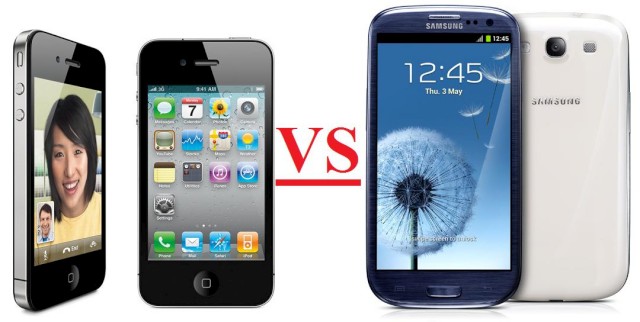
If the iPhone ever had a real challenger to its lofty position atop the smartphone throne, it was last year's impressive Samsung Galaxy S2. With the Galaxy S3 now fully revealed, Apple's mobile monster has renewed competition.
Both the iPhone 4S and the Samsung Galaxy S3 have a lot going for them, each with unique bonuses and drawbacks. We compare the key features and specs of both to help you decide which you should be splashing the cash on.
Design and Build Quality
iPhone 4S
Though it's a rehashed version of the iPhone 4 (with the dreadful antenna issues all ironed out) it's hard to fault the iPhone 4S design. Whether you grab it in black or white, the angular unibody design with chrome trim oozes style. It's arguably hit the sweetspot for mobile-phone size at 115.2 mm x 58.66 mm x 9.3 mm too. It does however lack a HDMI-out port, pretty much a standard with high-end Android handsets these days, and it's a little delicate, with its glass prone to shattering if dropped from even a modest height.
Galaxy S3
Thin at just 8.6mm and light at 133g, the Galaxy S3 feels great in the hand, and slips almost invisibly into a pocket. Available in Pebble Blue and Marble White, its curved edges are meant to conjure memories of nature. However, its plasticy "Hyperglaze" finish lacks that premium feel, and some may decide the Galaxy S3 is a little flimsy, albeit unfairly.
Winner - iPhone 4S Screen
iPhone 4S
The latest iPhone's Retina Display is pretty much as good as it gets for mobile display technology right now. Measuring 3.5 inches diagonally, it uses LED backlit IPS TFT LCD technology to deliver images at a staggering 326ppi. What the screen lacks in size it more than makes up for in detail, with vibrant colours, lush brightness and deep blacks.
Galaxy S3
A 4.8 inch Super AMOLED HD display sits on the front of the Galaxy S3 and it's gorgeous. Though its extra size and resolution mean it "only" hits a 309ppi pixel density, to the naked eye that won't make a difference. Vibrant and colourful, it dwarfs the iPhone 4S screen, which is a far less comfortable size to view videos on. Bigger, in this case at least, is better.
Winner - Galaxy S3
Processor
iPhone 4S Apple's 800Mhz dual-core A5 chip may sound a little dated in this age of quad-core mobile CPUs, but thanks to Apple's careful marriage of software and hardware, you'll never find the iPhone 4S being overly taxed. You'll fly through menu screens, tap away at breathtaking polygonal-3D gaming apps and playback detailed HD video without a stutter.
Galaxy S3
Samsung have popped a quad-core 1.4Ghz Exynos processor in the Galaxy S3. And despite having to push more pixels than the iPhone 4S (and running off the sometimes temperamental Android OS) there wasn't a stutter or hang to be seen. This is one powerful phone, best presented by the Pop Up Play feature that offers true picture-in-picture multitasking, offering windowed HD video playback. Impressive is an understatement.
Winner - Galaxy S3
Storage
iPhone 4S
Though Apple's iPhone 4S doesn't offer expandable storage, they at least offer three different configurations when it comes to size. 16GB, 32GB and 64GB iPhone 4S models are all available, with pricing rising appropriately. It's a crafty tactic though, as those opting for more storage space have to pop money directly into Apple's coffers, rather than picking up cheaper expandable storage elsewhere. With the iCloud back-up feature too you've got a little leeway with which to store files remotely too, though extensive cloud storage through Apple doesn't come cheaply.
Galaxy S3
Samsung's generous storage options make Apple look very cheap here. For starters, you've got the same 16GB, 32GB and 64GB handset options. Add on to that the option of popping in as much as an extra 64GB from a microSD card. Then pile on top the 50GB of FREE Dropbox cloud storage that comes as standard with every Galaxy S3 purchase. There's no competition here.
Winner - Galaxy S3 Battery
iPhone 4S
The iPhone 4S is said to have 200 hours worth of battery standby time, 8 hours talk time on 3G, 14 hours talk time on 2G, 6 hours 3G browsing, 9 hours Wi-Fi browsing, 10 hours of video playback or 40 hours of audio playback. In reality however, you're going to be juggling through all these tasks (at times simultaneously) throughout a day, meaning that you're going to need to recharge that battery long before the day is done.
Galaxy S3
Samsung have popped in a whopping 2100mAh battery in the Galaxy S3. It sounds awesome, but remember there's a massive screen to power, as well as a quad-core processor draining juice all the time. Touches like the Smart Stay tech should keep battery usage as low as possible, but we can't pass judgement here till we've put the phone through its paces for a bit longer. We'll call it a tie for now.
Winner - Tie
Software and Apps
iPhone 4S
Apple say there's an app for everything, and with the iOS App Store, that's pretty much true. With over 500,000 different apps available in Apple's store, there's pretty much an app to cater for every potential need. From fitness to finance, arts to archaeology, you name it, there's a shed load of apps for every possible niche. Gaming in particular is well served on the iPhone, with it more than a match for handhelds like the Nintendo 3DS or PS Vita these days. Just check out Infinity Blade 2 if you need convincing.
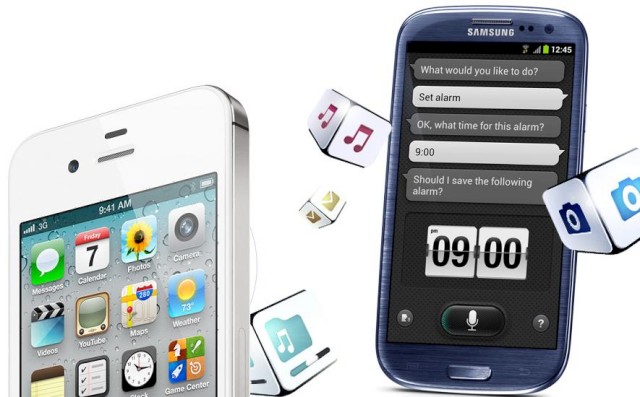
The iPhone 4S also features the much-publicised Siri voice control app. With it, you can search the web, set calendar reminder, dictate emails and much more with just your voice alone. In the US it's a fully-featured service that has a giant database of details on local businesses and events. In the UK, it's far less comprehensive in terms of what it can do, making it a bit of a novelty for the time being.
As for the iOS operating system itself, it's incredibly easy to use and looks beautiful. It pretty much invented the grid-based app layout that everything from the Xbox 360 to Roku entertainment players have ripped off since. It is also however incredibly limited in terms of customisation, and if you're a tinkerer who likes to get under the hood of his device and tweak every property and potential UI layout, it's not a patch on Android.
Galaxy S3
The Galaxy S3 runs Android Ice Cream Sandwich. When it comes to apps, Android just can't compete with iOS. For starters there are fewer apps available, and they tend to be uniformly less visually appealing than similar ones available on the Apple App Store.
Likewise, Android is a far less user-friendly OS, but what it lacks in dummy-proofing, it excels with customisation options. You can make your Android look and act pretty much however you want it to, freely adding widgets and personal touches throughout the device.
Samsung have also gone a long way to stamping their own touches into the software of the phone too. As well as the aforementioned Pop Up Play feature, there's superfast data sharing over NFC with S Beam, intelligent facial recognition and photo tagging capabilities, eye-tracking screen dimming tech called Smart Stay and their own Siri rival called S Voice.
Winner - iPhone 4S Camera and Video Recording
iPhone 4S
Though its megapixel count of 8 isn't any higher than the majority of top-tier smartphones the iPhone 4S's imaging systems consistently deliver stunning results. Using a lens with an aperture of f/2.4, and combining that with clever HDR and Macro software, you get excellent still image results almost every time. A super-fast shutter speed that lets you snap multiple images directly after each other sweetens the deal, as do the many superb photography apps on the App Store. However, you can't tweak sensitivity settings like white balance and exposure, which may irk pro photographers.
1080p video recording with anti-shake functionality likewise returns brilliant results on the iPhone 4S, with the iMovie app letting you make a few simple edits on the go.
Galaxy S3
Samsung's top-tier smartphone camera seems every bit as good as the iPhones. Again, it's an 8MP offering, with impressive start up speeds of 990ms, and the ability to fire off 3.3 photos a second. A 20 in a row, six photos per second, burst mode also features, alongside Best Shot, which takes 8 pictures and picks out the best based on framing, lighting and blur, as well as elements such as open or closed eyes on the subject.
Then there are the facial recognition features. Snap a friend, tag them in one photo, and every subsequent picture you take of them in the future should automatically be tagged accurately by the handset. Groups of people appearing in the same shots can also have group tags associated with them, making organising large photo libraries incredibly easy. Images can quickly be shared via email or social networks using this feature too.
Elsewhere, more standard features like High Dynamic Range (HDR), panorama, Smile Shot and Beauty Modes are onboard too, as well as plenty of manual settings for things like Exposure values.
Though we spent less time with it, 1080p video recording is also onboard. Just like the S2 before it, the results from our early tests looked a real treat, with video stabilisation options working superbly. Up front, a 1.9MP camera for video calling and shooting 720p video is also available.
Winner - Tie
Price
iPhone 4S
Unlocked, the iPhone 4S in 16GB, 32GB and 64GB sizes cost £499, £599 and £699 respectively.
Galaxy S3
We're still waiting for official pricing for the Galaxy S3, but if the Galaxy S2 was anything to go by, expect premium pricing. The S2 started at around £500 SIM-Free too depending on retailer, so we'd imagine things to be similar with the Galaxy S3.
Winner - Tie
Overall Winner - Samsung Galaxy S3
There's not much in it, and the Apple faithful will likely see nothing that will make them change their ways, but our first impressions of the Galaxy S3 suggest it may be the best smartphone on the market today. A great camera, superb screen and innovative software features show Samsung have really pushed the boat out with the Galaxy S3. If the price proves right, and the battery is up to scratch, we could have a new smartphone king on our hands. Remember though, the iPhone 4S is based on a design (that of the iPhone 4) that is now a couple of years old. With the iPhone 5 launch almost certainly looming, the tables could turn yet again very quickly...